Your Digital Bodyguard: How Agentic AI Is Revolutionizing eCommerce Security
Quick Summary (TL;DR)
• The Problem is Scale: In 2025 alone, over 48,000 new vulnerabilities were disclosed. Manual security teams can't keep up, leaving your store exposed.
• The Solution is Agentic AI: Instead of one AI, imagine a team of specialized AI agents that automatically find, validate, and create defenses against threats, working 24/7.
• It's Not Just Faster, It's Smarter: Systems like Amazon's 'RuleForge' use a separate "judge" AI to evaluate security rules, reducing false alarms by 67% and achieving a 336% productivity boost over human analysts.
—
Ever had that nightmare? The one where you wake up, grab your coffee, and open your laptop only to find your beautiful eCommerce site has been replaced with a skull and crossbones? Or worse, a subtle bit of code has been skimming your customer's credit card data for weeks.
For online sellers, this isn't just a bad dream; it's a very real, very expensive possibility. The internet is a chaotic digital jungle, and the number of threats is exploding. We're talking about a new software vulnerability being discovered roughly every 10 minutes. Your security team, if you even have one, is drinking from a firehose.
But what if you could hire a team of tireless, hyper-intelligent security guards who work 24/7, speak the language of hackers, and fix security holes before you even know they exist? That's the promise of agentic AI for vulnerability detection. It's not just another buzzword; it's a fundamental shift in how we defend our digital storefronts.

What on Earth is Agentic AI for Vulnerability Detection?
Alright, let's cut the jargon. Forget visions of a single, all-knowing Skynet. Think of agentic AI as a highly specialized digital assembly line. Instead of one general-purpose AI trying to do everything, you have a team of AI “agents,” each with a specific job.
- One agent's entire existence is dedicated to scouring the internet for new threat reports.
- Another agent takes that report and tries to write code that could exploit the vulnerability.
- A third agent—the “judge”—critiques that code, looking for flaws.
- Finally, a fourth agent writes the defense rule and passes it to a human for the final green light.
It's a collaborative system of bots, designed to mimic—and massively speed up—the workflow of an elite human security team.
Why This Isn't Just Hype: The Real-World Impact
This isn't some far-off sci-fi concept. It's happening now, and it's changing the game for businesses that rely on the internet to make money (so, basically everyone).
Closing the Gap Between Threat and Defense: The Need for Speed
The moment a vulnerability is announced, a global race begins. Hackers race to exploit it, and security pros race to patch it. The problem? Humans need to sleep, eat, and take coffee breaks. Hackers don't.
Amazon's agentic AI system, RuleForge, enabled their team to produce and validate security rules 336% faster than they could manually. That's not an improvement; it's a revolution.
This speed means the window of opportunity for attackers shrinks from days or weeks to mere hours or minutes. For an eCommerce store, that's the difference between a normal sales day and a catastrophic data breach.

Smarter, Not Just Faster: The Power of AI Collaboration
Anyone who has worked in a team knows that having someone to check your work is invaluable. It turns out the same is true for AI. One of the biggest breakthroughs in agentic AI is the use of a separate “judge” model.
The AI that generates the security rule is inherently biased; it thinks its own work is great. But the judge AI is a ruthless critic. Its only job is to poke holes in the proposed solution. This adversarial process is incredibly effective.
By separating the “creator” from the “critic,” systems like RuleForge reduced false positives by a staggering 67%. For a business owner, this means your security system isn't constantly crying wolf, allowing you to focus on the real threats.
Under the Hood: How Agentic AI Finds Vulnerabilities
So how does this digital team actually work? Let's break down the process into a few simple steps, based on how real-world systems operate.
Step 1: Automated Threat Ingestion & Triage
It all starts with information. An agent constantly scans public databases (like the National Vulnerability Database), security blogs, and hacker forums for any mention of a new exploit. It then analyzes this data, automatically prioritizing the most severe threats. It’s like having a security guard who reads every newspaper and intelligence report on earth, instantly.
Key Tip: This isn't just about finding threats; it's about ranking them. The AI focuses on what can actually harm your type of system, ignoring the noise.
Step 2: Parallel Generation & The 'AI Brainstorm'
Once a critical threat is identified, the system doesn't just create one solution. It spins up multiple “generation agents” that all try to solve the problem simultaneously, each taking a slightly different approach. It's like a brainstorm session with five of your smartest engineers, but it happens in seconds.
Key Tip: This parallel process allows the system to explore multiple defense strategies at once, increasing the odds of finding the most robust and efficient solution.
Step 3: The 'Judge' Model and Rigorous Validation
This is the magic step. Each proposed security rule is handed over to the “judge” agent. The judge asks tough questions:
- “Will this rule accidentally block legitimate customers?” (Specificity)
- “Does this rule have loopholes a clever hacker could bypass?” (Sensitivity)
Rules that fail are sent back to the generation agents with feedback. The ones that pass move on to be tested against real-world and synthetic data before a human makes the final call.
Agentic AI in Practice: Best Practices for Implementation
Decomposing the Problem: Specialized Agents Over a Single 'Genius' AI
The biggest lesson from successful agentic AI systems is to resist the urge to use a single, massive Large Language Model (LLM) for everything. The real power comes from breaking down a complex task—like vulnerability detection—into smaller, manageable jobs and assigning a specialized AI to each.
Keeping Humans in the Loop: The Final Gatekeeper
Even with a 336% productivity boost, the final “deploy” button is still pushed by a human. AI is a powerful tool to augment human expertise, not replace it entirely. The system does 99% of the heavy lifting, freeing up human engineers to focus on strategic oversight and final verification. This human-AI partnership is the gold standard for modern security.
From Theory to Reality: A Look at Amazon's 'RuleForge'
The Challenge: Drowning in Vulnerability Alerts
Amazon, like any massive online entity, faces a constant barrage of potential threats. Their security analysts were spending countless hours manually downloading exploit code, writing detection logic, and validating it against massive traffic logs. The process was slow, meticulous, and couldn't possibly keep up with the firehose of new CVEs.
The Solution: A 336% Productivity Boost with Agentic AI
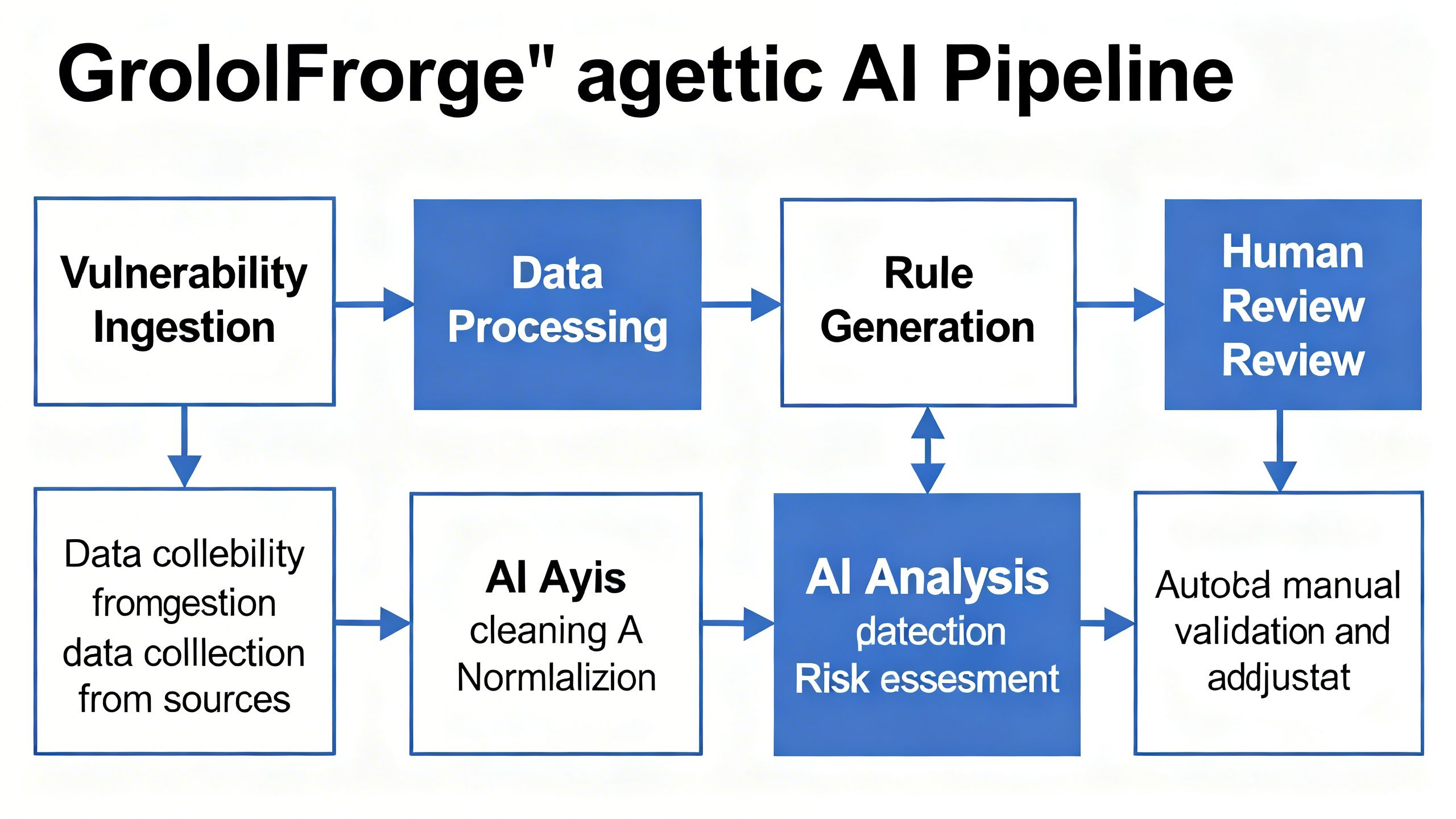
By implementing RuleForge, they transformed this manual workflow into an automated, agentic pipeline. Analysts shifted from being rule authors to rule reviewers. The system automatically ingests threats, generates and validates rules, and presents the best option to the human expert for a final check. The result was a massive increase in throughput without sacrificing quality, allowing them to cover more threats and protect customers more effectively.
Common Pitfalls to Avoid When Adopting AI Security

The 'One-Model-to-Rule-Them-All' Fallacy
Many companies make the mistake of trying to use a single, general-purpose AI to solve their security problems. Research shows that LLMs are notoriously bad at judging their own work, often reporting high confidence in flawed outputs. The key is an architecture of specialized agents, especially the separate “judge” model, to ensure accuracy.
Forgetting the Human Element
Another common mistake is trying to fully automate security and remove humans from the loop. The most effective systems use AI to handle the scale and speed, but rely on human judgment for the final, critical decisions. Your human experts are your most valuable asset; AI should be their most powerful tool.
Why TrackIQ Matters: Connecting Security Insights to Business Performance
So, you've used agentic AI to build a digital fortress around your eCommerce business. Your site is secure, stable, and ready for customers. Now what?
Security is the foundation, but growth is the goal. Once your store is protected from external threats, the next challenge is understanding what's happening inside your business. Are your sales campaigns working? Is your inventory optimized? Are you losing money on shipping?
This is where the same principle of AI-driven insight applies. Just as security agents analyze threat data, TrackIQ’s own AI-powered agent sifts through your complex Amazon sales data to give you clear, actionable answers. You don't need to be a data scientist to ask questions like:
- “Which of my products had the biggest drop in profitability last month?”
- “Show me the ACoS for my new ad campaign compared to my best-seller.”
Protecting your business is non-negotiable. But growing it requires a different kind of intelligence. While agentic AI guards the gates, platforms like TrackIQ give you the map to navigate the territory inside.
Key Takeaways for Your eCommerce Business
- Proactive Defense is the New Standard: Waiting for a breach is no longer an option. Agentic AI for vulnerability detection is a proactive tool that defends your business around the clock.
- Architecture is Everything: The success of these systems lies in their design: multiple specialized agents, a separate “judge” for quality control, and a human in the loop for final approval.
- Focus on What You Do Best: You don't need to build your own agentic AI. But understanding how it works helps you choose better security partners and tools, so you can focus on what you do best: selling products and growing your brand.
Conclusion
The shift from manual security analysis to automated, agentic AI is as significant as the shift from hand-cranked cash registers to digital POS systems. It’s a force multiplier that allows businesses to operate with a level of security that was once only available to tech giants.
By embracing this technology, you’re not just buying a better lock for your door; you’re investing in the stability and resilience your business needs to thrive. You’re freeing up mental energy from worrying about threats to focusing on opportunities. And once you're secure, it's time to optimize. Tools are now available to help you see how TrackIQ automates your reporting and turns complex data into simple decisions for growth.
—