Your Code's Bodyguard: A Plain-English Guide to Formal Verification for eCommerce

Quick Summary (TL;DR)
• Banish Critical Bugs: Formal Verification for eCommerce isn't just academic theory; it's a practical way to mathematically prove your most critical code (like payment gateways) is free of catastrophic bugs.
• From Guesswork to Guarantees: Unlike traditional testing which hunts for bugs, formal verification proves their absence, giving you mathematical certainty that your software behaves exactly as intended.
• Security & Savings: By eliminating entire classes of vulnerabilities and errors before they ever go live, you prevent costly data breaches, system failures, and lost revenue, turning a security practice into a massive ROI driver.
—
Picture this: It's Black Friday. Your traffic is surging. Suddenly, a single, undiscovered bug in your checkout process starts miscalculating discounts. By the time you notice, you've lost six figures. This isn't a horror story; it's a Tuesday for some unlucky eCommerce brands. We spend millions on marketing to get customers to the checkout, only to have our own code betray us at the last second. We test, we QA, we cross our fingers and hope for the best. But what if there was a way to prove it wouldn't happen?
This is where Formal Verification for eCommerce comes in. Forget the dusty academic papers and intimidating jargon. Think of it as hiring a world-class mathematician to act as a 24/7 bodyguard for your code. It’s a method of using rigorous mathematical logic to check your system against a set of rules, ensuring it’s not just probably right, but provably correct. In a world where a single line of faulty code can tank your reputation and your profits, moving from “we think it works” to “we can prove it works” is the ultimate competitive advantage.
So, What Exactly is This 'Formal Verification' Sorcery?
At its core, formal verification is the process of using mathematical proof to confirm that a system (like your inventory management software or payment API) adheres to a specific set of properties or rules.
Let's use an analogy. Imagine building a skyscraper.
- Traditional Testing is like sending a team of inspectors to walk around the finished building. They'll check for cracks, test the elevators, and make sure the windows don't leak. They can find a lot of problems, but they can't check every single rivet and weld under all possible weather conditions.
- Formal Verification is like giving your architect's blueprints to a team of physicists and engineers before construction begins. They use the laws of physics and material science to mathematically prove that the design is sound and will not collapse, even in a Category 5 hurricane.
It doesn't guess; it calculates. It doesn't search for errors; it proves their absence. This is a profound shift for eCommerce developers and security engineers who are used to the endless cycle of patch, pray, and repeat.
Why Formal Verification is Your eCommerce Empire's Secret Weapon
Adopting formal methods isn't just about writing better code; it's about building a more resilient, secure, and profitable business. The benefits ripple out from your codebase to your bottom line.
Eliminate Billion-Dollar Bugs Before They're Born
The cost of a software bug isn't just the developer time to fix it. For an eCommerce business, it's lost sales, angry customers, and brand damage. A 2018 report found that software failures cost the U.S. economy over $1.7 trillion. Formal verification targets the most critical, high-risk parts of your operation.
By proving that your checkout logic can't accidentally give away products for free or that your inventory system can't sell out-of-stock items, you're not just fixing bugs—you're preventing financial disasters. It’s the cheapest, most effective insurance policy you can buy for your platform.
Build Fort Knox-Level Security
Many security vulnerabilities, like buffer overflows or integer overflows, aren't just simple mistakes; they are logical flaws in the code's design. Penetration testing and scanners can find known vulnerabilities, but what about the unknown ones? The “zero-day” exploits?
Formal verification can prove that certain classes of vulnerabilities are impossible in your system. For example, the Amazon Web Services team used formal verification to prove the security of its s2n-tls implementation, a critical piece of internet infrastructure. They didn't just test it for weaknesses; they proved its logical soundness, making it exponentially harder for attackers to find a foothold. This is the essence of a truly robust security posture.

The Three-Step Dance of Digital Invincibility
Getting started with formal verification for eCommerce might sound like you need a Ph.D. in computer science, but the process is quite logical. It boils down to three main stages.
Step 1: Writing the Rules: The Art of Specification
This is the most critical—and most human—part of the process. You can't prove your code is correct if you haven't precisely defined what “correct” means. A specification is a formal, unambiguous set of rules your code must follow.
- Example: For a shopping cart, a specification might be:
The total price must always equal the sum of the prices of the items in the cart, minus any applied discounts.OrA customer cannot complete a purchase if their payment method is declined.
Key Tip: Start with your most critical business logic. Don't try to specify your entire application. Focus on the 5% of your code that handles 95% of the risk, like payment processing, inventory updates, and user authentication.
Step 2: Building the Model: Your Code's Digital Twin
Next, you create a mathematical model of your system. This isn't the code itself, but an abstraction that captures its behavior. This model is what the verification tools will analyze. Modern tools can often generate this model directly from your source code with annotations.
Key Tip: The level of abstraction is key. A model that is too detailed can be too complex to verify (a problem known as “state space explosion”), while one that is too simple might miss crucial behaviors. It's a balance of precision and practicality.
Step 3: Let the Machines Do the Work: Automated Proofs
This is where the magic happens. You use an automated tool, like a model checker or a theorem prover, to check your model against your specification. The tool will exhaustively explore every possible state your system can enter and check if any of them violate your rules.
- If it finds a violation, it will provide a counterexample—a specific sequence of events that leads to the failure. This is an incredibly powerful debugging tool.
- If it explores all states and finds no violations, you have a mathematical proof that your code is correct with respect to your specification.
Formal Verification in the Wild: Best Practices
Start Small, Win Big: Focus on Critical Components
Don't try to formally verify your entire frontend UI. It's not practical or necessary. The highest ROI comes from applying formal verification to the small, complex, and mission-critical components of your backend.
Think about the code that, if it failed, would cause you to lose sleep. That's your starting point. Is it your promotion engine? Your shipping calculator? Your data encryption library? Isolate it, specify it, and verify it.
Combine with Traditional Testing: The Best of Both Worlds
Formal verification is not a silver bullet that replaces all other forms of testing. It's a powerful addition to your quality assurance toolkit.
- Formal Verification is for proving the correctness of your core logic.
- Traditional Testing (unit, integration, E2E) is for validating the overall system behavior, user experience, and integration with third-party services.
Use them together. A formally verified payment module combined with a comprehensive suite of integration tests is far more robust than either approach alone.
Real-World Proof: How Amazon Secures the Future
If you think this is all theoretical, look no further than Amazon. Their Automated Reasoning Group (ARG) is a leader in applying formal verification to solve real-world, high-stakes problems, particularly in cryptography.
The Post-Quantum Challenge: Defending Against Future Threats
One of the biggest looming threats in cybersecurity is the “store now, decrypt later” attack. Malicious actors are already recording encrypted data today, betting that they'll be able to crack it in the future with quantum computers. To counter this, new post-quantum cryptography (PQC) algorithms are being developed, like ML-KEM.
But implementing these complex algorithms correctly is notoriously difficult. A tiny mistake could render the entire encryption useless.
Building mlkem-native: Verified, Fast, and Safe
Instead of just writing the code and testing it, Amazon's team set out to prove its correctness. They built mlkem-native, an open-source implementation of the ML-KEM standard.
- Challenge: Fast code is often complex and hard to audit. Simple code is easy to audit but slow. They needed both speed and security.
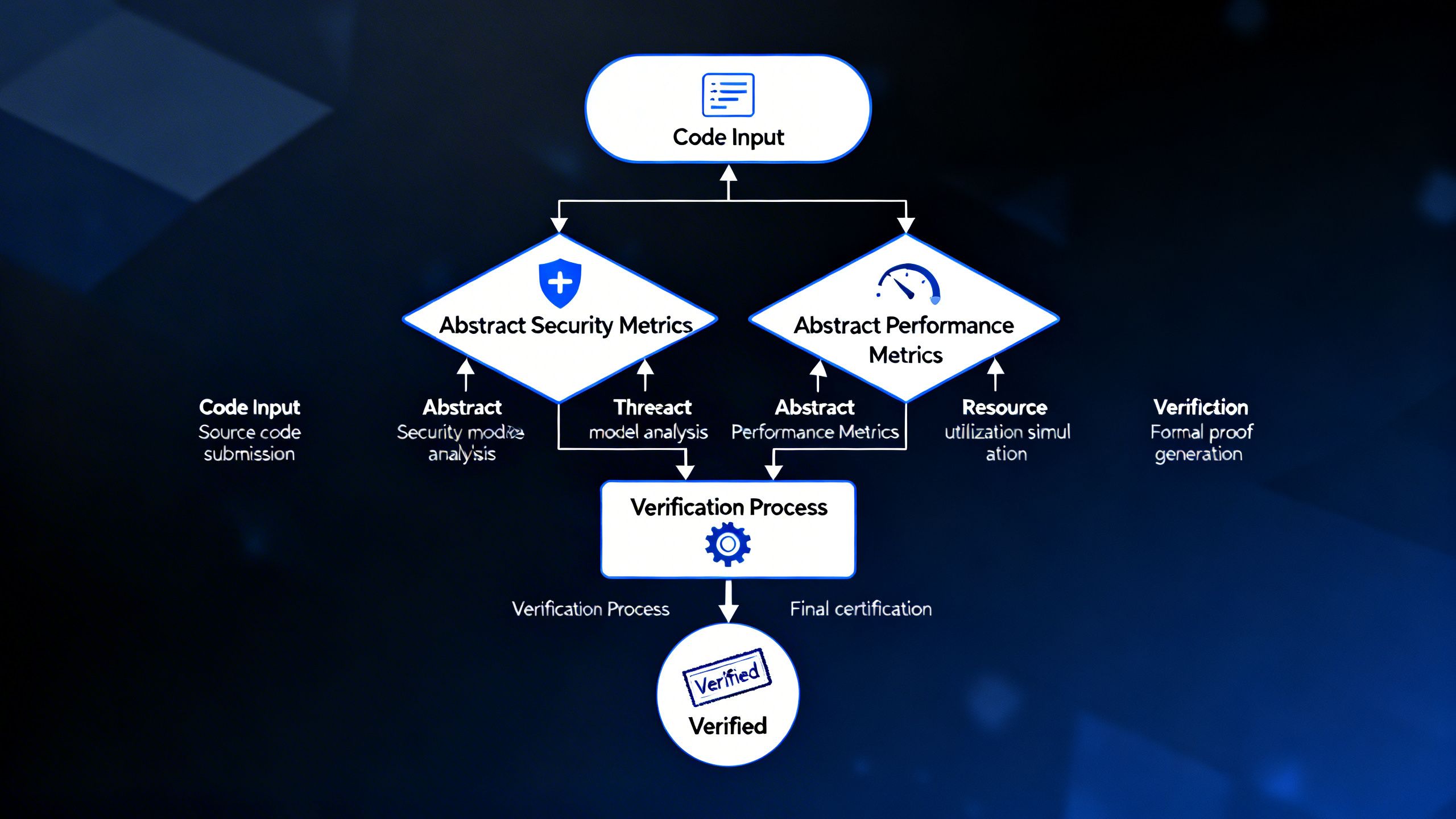
- Solution: They used a tool called the C Bounded Model Checker (CBMC) to automatically verify that the C code was free from memory safety and integer overflow errors—common sources of catastrophic vulnerabilities. For the most performance-critical parts written in assembly, they used other tools (HOL Light, s2n-bignum) to prove the mathematical correctness of the hand-optimized code.
- Result: An implementation that is up to 2.4x faster than the reference code and comes with mathematical proof of its safety and correctness. They didn't have to choose between performance and security; formal verification gave them both.
Avoiding the Landmines: Common Formal Verification Pitfalls
The 'Boil the Ocean' Approach: Trying to Verify Everything
The most common mistake is trying to apply formal verification to your entire codebase. This is a recipe for failure. It's time-consuming, expensive, and yields diminishing returns. The goal is not 100% verification coverage; it's 100% verification of your 1% most critical code.
The Specification is Wrong: Garbage In, Garbage Out
Formal verification only proves that your code meets its specification. If your specification is incomplete or just plain wrong, you'll have a perfectly correct implementation of a flawed design. The time spent refining and reviewing your specifications is the most valuable investment in the entire process.
From Verified Code to Verified Insights: Why TrackIQ Matters
So, you've used formal verification to build an unbreakable, mathematically sound foundation for your eCommerce platform. Your systems are reliable. Your data is secure. What's next?
The same principle of trusting your foundation applies to your business intelligence. A flawless system that generates messy, unreliable data is just as dangerous as a buggy one. You need to trust the insights you're using to make decisions.
This is where the philosophy aligns perfectly with tools like TrackIQ. Just as formal verification provides proof, not guesses, about your code's behavior, TrackIQ is designed to provide clear, verified answers from your business data. When you ask a question, you get a real answer based on your actual Amazon data—not a hallucination. You can explore how it works and see that the goal is to eliminate ambiguity.
Formal verification ensures your code isn't lying to you. TrackIQ ensures your data isn't lying to you.
In a way, the AI-powered agent in TrackIQ acts as your data's formal verifier. It refines raw, chaotic information from Seller Central into pristine, actionable insights. Instead of spending hours in spreadsheets trying to prove a hypothesis about your sales trends, you can simply ask and get a trustworthy answer. This is the natural extension of building on a reliable foundation—moving from trusted code to trusted decisions. You can learn more about how this agentic approach transforms data dumps into decision-making tools.
The Future is Formally Verified
As eCommerce systems become more complex and the stakes get higher, the old ways of ensuring quality are no longer enough. We're moving from an era of “hopeful testing” to an era of “provable correctness.”
- Takeaway 1: Formal verification is no longer an academic curiosity. It's a practical, ROI-driven engineering discipline that gives you a powerful competitive advantage.
- Takeaway 2: You don't need to be a mathematician to get started. Begin by identifying the most critical component of your system and focus your efforts there.
- Takeaway 3: A foundation of reliable code is the first step. The ultimate goal is to build a business that runs on reliable, verifiable information, from the lowest-level function to the highest-level strategy.
Conclusion
Building an eCommerce business is hard enough without having to worry that your own code will sabotage you. Formal verification for eCommerce offers a path forward—a way to build systems that are not just feature-rich, but fundamentally sound. It’s about trading anxiety for assurance. By investing in provable correctness for your most critical systems, you free up resources, prevent disasters, and build a platform that customers can trust.
Ready to build an unbreakable foundation for your eCommerce business? It starts with code you can trust. And once you have that trust, you can unlock a new level of data-driven growth with tools designed for clarity and action. See how TrackIQ turns reliable data into decisive action.
—