Your New eCommerce Co-Pilot: How Agentic AI Knows When to Help (and When to Shut Up)

Quick Summary (TL;DR)
• AI as a Colleague, Not a Calculator: Agentic AI isn't just another automation tool; it's a proactive partner that can execute multi-step tasks, from market research to ad campaign adjustments. The trick is learning how to manage it.
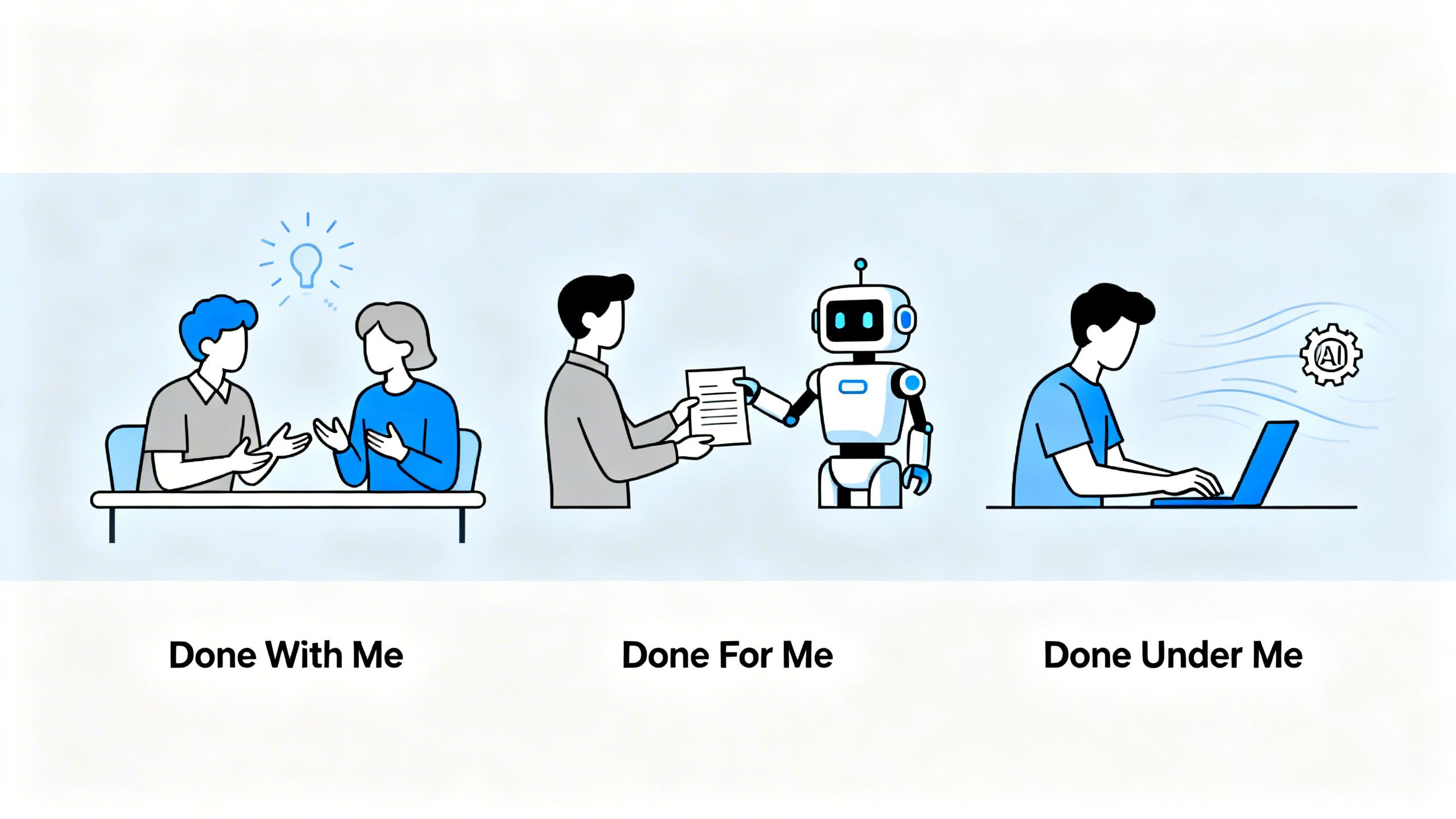
• The Three Flavors of AI Help: The best human-AI collaboration happens in three modes: “Done With Me” (close collaboration), “Done For Me” (delegated tasks), and “Done Under Me” (invisible background help). Knowing which to use is crucial.
• Control is Not a Dirty Word: The biggest risk with powerful agentic AI is letting it run wild without oversight or micromanaging it into uselessness. The sweet spot is a system that provides transparency and control, letting you be the strategist, not the button-pusher.
—
Ever feel like you’ve hired a brilliant, hyper-caffeinated intern who has access to all your data? One minute, they’re uncovering a game-changing insight about your top-selling ASIN. The next, they’ve re-written all your product descriptions in Klingon because they “detected a market opportunity.” That’s the promise and peril of Agentic AI in eCommerce. It’s not just about asking questions; it’s about giving AI the keys to the car. But how do you make sure it doesn’t drive off a cliff?
We’re moving beyond the era of AI as a glorified search bar. The next wave is about agents—AI systems that don’t just find information, but take action. They can plan, execute, and adapt. For Amazon sellers and agencies, this is a seismic shift. It promises a future where you’re not buried in spreadsheets, but instead directing a team of digital experts. This guide will break down how to harness this power without losing control, turning your AI from a chaotic intern into a trusted co-pilot.
What in the World is Agentic AI, Anyway?
Let's cut the jargon. Traditional AI is like a calculator; you give it a problem (2+2), and it gives you an answer (4). Agentic AI is like hiring a freelance accountant. You give it a goal (“Figure out my Q3 profitability and find areas to cut costs”), and it goes off, gathers the data, runs the numbers, builds a report, and presents you with a strategy. It’s a system that can perform a sequence of operations autonomously to achieve a goal.
In eCommerce, this means an AI that can:
- Monitor competitor pricing and automatically adjust your bids.
- Analyze sales data to identify a new product bundle opportunity.
- Conduct research on emerging market trends and draft a report.
It’s proactive, conversational, and capable of complex, multi-step tasks. It’s the difference between asking for a weather report and asking your AI to book you a flight to a sunny destination if it looks like rain next week.
Why This Isn't Just More Tech Hype
The shift to agentic systems is about reclaiming your most valuable asset: strategic focus. Instead of getting bogged down in the how, you can focus on the what and why.
Reclaim Your Time: From Manual Labor to Strategic Direction
Think about the hours spent pulling reports, cross-referencing spreadsheets, and tweaking ad campaigns. It’s a grind. An agentic system treats these tasks as a to-do list it can work through while you sleep.
A recent study found that managers spend over 50% of their time on administrative coordination and control tasks. Agentic AI aims to slash that number, freeing up human capital for innovation and growth.
This isn't just automation; it's delegation. You're not just setting rules; you're providing intent and letting the agent figure out the execution. This is how 7-figure sellers become 8-figure sellers—by building systems that scale beyond their personal bandwidth.

Uncover Insights You Didn't Know to Look For
Your business data is a goldmine, but most of us are just scratching the surface with a plastic shovel. An agentic AI can be tasked with the broad goal of “finding opportunities for growth.” It can then dig through your sales, advertising, and inventory data, connecting dots a human might miss.
For example, it might notice that a product you sell as a standalone item is frequently purchased with another. It could then run a margin analysis, research competitor bundles, and propose a new “Frequently Bought Together” strategy, complete with projected revenue uplift. It’s like having a 24/7 business analyst on your team.

The Operator's Manual: How to Work With Your New AI Colleague
Amazon’s AI researchers have a great framework for this, which boils down to three modes of human-AI coordination. Getting this balance right is the key to success.
Done With Me (The Collaborative Brainstorm)
This is high-touch collaboration. You and the AI are working together, back-and-forth, like partners at a whiteboard. This mode is perfect for high-stakes, complex tasks where human intuition is critical.
- eCommerce Example: Planning a new product launch. You work with the AI to analyze market gaps, define the target audience, and brainstorm marketing angles. The AI provides data and analysis; you provide the strategic direction and final say.
Key Tip: Use this mode for anything that requires creative input or has a significant budget attached. Don't abdicate strategic thinking; augment it.
Done For Me (The Autonomous Workhorse)
Here, you delegate a specific, well-defined task and trust the AI to handle it with minimal oversight. You initiate the task and review the final output, but the messy middle is handled autonomously.
- eCommerce Example: “Generate a weekly performance report for my top 10 ASINs, including sales velocity, ad spend, and ACoS. Highlight any products with a sudden drop in performance.” The AI does the work and delivers a finished report to your inbox.
Key Tip: This is ideal for repetitive, data-heavy tasks. The key is to be incredibly specific with your instructions to avoid garbage-in, garbage-out results.
Done Under Me (The Invisible Assistant)
This is the most subtle form of agentic AI. It works in the background, making small optimizations without needing to announce itself. The user might not even be aware it's happening.
- eCommerce Example: A smart system that subtly re-sorts product recommendations on your storefront based on a user's real-time browsing behavior, or an AI that makes micro-adjustments to your PPC bids throughout the day to stay competitive.
Key Tip: This requires a high degree of trust in the system. It's essential to have a platform that provides transparency so you can audit these background actions if needed. This is where building trusted AI becomes non-negotiable.
Agentic AI in the Wild: Real-World eCommerce Scenarios
Theory is great, but let's talk about what this looks like at the coalface of eCommerce.
Inventory Management: From Panic-Buying to Predictive Reordering
- The Challenge: You’re either running out of stock on your bestsellers during peak season or you’re sitting on a mountain of capital-sucking dead inventory.
- The Agentic Solution: You set a goal for your AI: “Maintain a 95% in-stock rate for all A-grade products without exceeding 45 days of cover.”
- The AI works in Done Under Me mode, constantly monitoring sales velocity and supply chain lead times.
- When it predicts a stockout, it shifts to Done For Me mode, drafting a purchase order and sending it to you for approval.
- If there’s a sudden, unexpected sales spike, it switches to Done With Me mode, alerting you with a full analysis and recommending several options (e.g., expedite shipping, reallocate ad spend).
PPC Campaign Optimization: From Guesswork to Surgical Precision
- The Challenge: You know you need to adjust bids, harvest new keywords, and negate poor performers, but you don't have time to do it daily across hundreds of campaigns.
- The Agentic Solution: You give the AI a target ACoS and a budget.
- The AI works Done Under Me, making small, hourly bid adjustments to win profitable placements.
- Weekly, it operates in Done For Me mode, delivering a report of newly discovered high-performing keywords and suggesting they be moved to dedicated campaigns.
- If it detects a competitor is suddenly bidding aggressively on your top brand term, it escalates to Done With Me, notifying you and asking for a decision on how to respond.
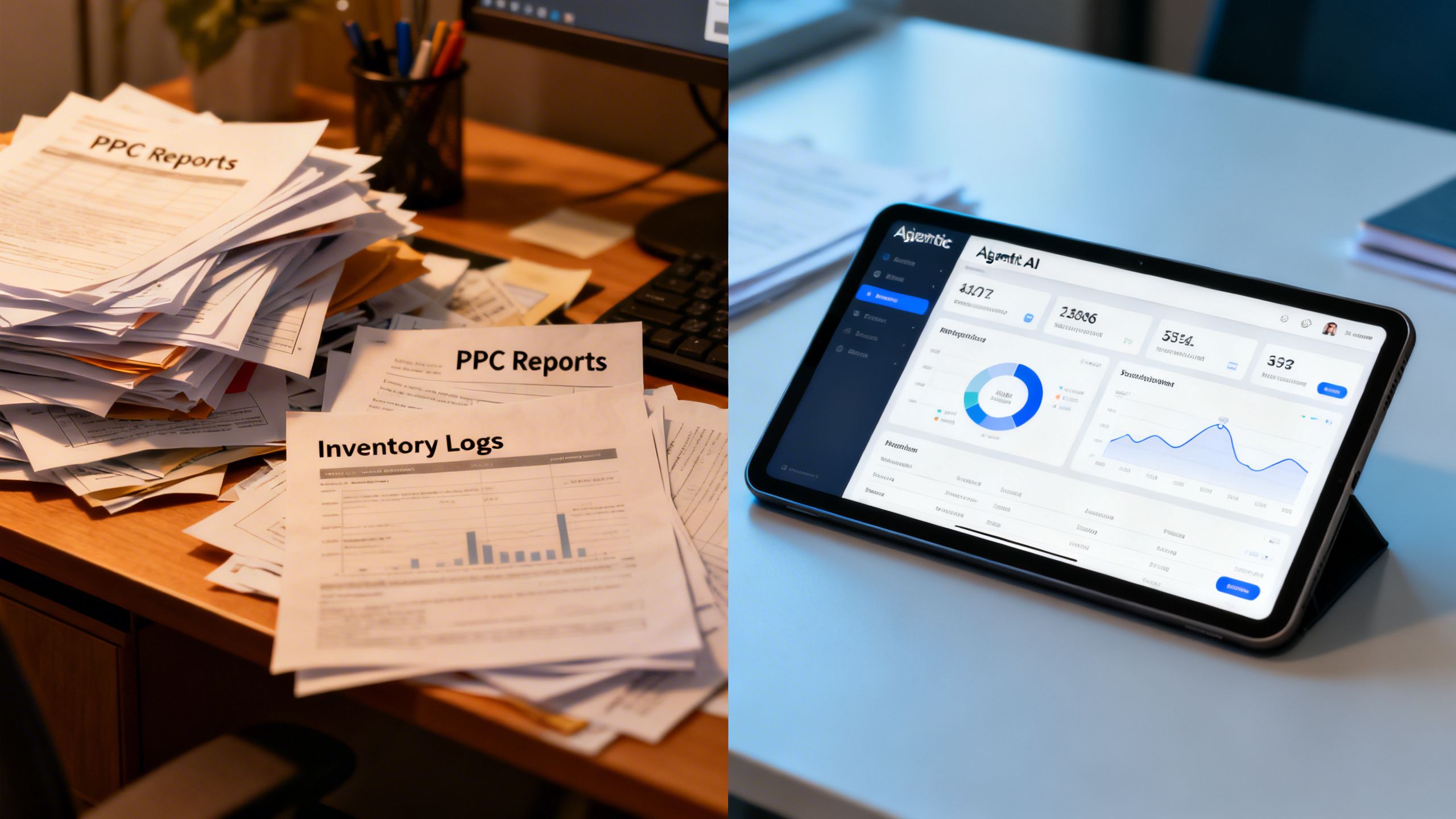
The Pitfalls: How to Neuter Your Expensive New AI
Adopting agentic AI isn't without its traps. Here are the two most common ways sellers get it wrong.
The “Set It and Forget It” Delusion
This is the most dangerous mistake. You get excited by the promise of automation, hand over the keys, and stop paying attention. An agentic AI is a powerful system, but it’s not omniscient. It operates on the data and constraints you give it. Market conditions change, competitors adapt, and your goals shift.
Treating an agentic AI like a simple thermostat is a recipe for disaster. It's a co-pilot that needs a flight plan and regular check-ins, not a self-flying plane with no pilot.
How to avoid it: Schedule regular check-ins. Review the AI’s decisions and outputs. The goal is to build trust, but trust requires verification. You need a system that makes this auditing process easy and transparent.
The Micromanagement Mire
The opposite problem is just as bad. You buy a powerful tool designed for autonomous action and then demand approval for every tiny decision. This turns your AI from a force multiplier into a glorified notification system. You’re paying for a race car and then driving it in first gear with the parking brake on.
How to avoid it: Start small. Delegate low-risk, repetitive tasks first. As you build confidence in the system’s outputs, gradually increase its autonomy. Use the “Done With Me” and “Done For Me” frameworks to consciously decide the appropriate level of oversight for each task.
Why TrackIQ Matters: Building Your AI Co-Pilot the Right Way
This all sounds great in theory, but it requires a platform built for this new way of working. A simple dashboard won't cut it. This is where TrackIQ is fundamentally different. We didn't just bolt an AI chatbot onto a spreadsheet; we built an agentic platform designed for collaboration.
TrackIQ embodies the principles of adaptive coordination. It’s designed to be your Done With Me partner. You can have a conversation with your data, asking complex questions and getting real answers. You can ask it to explore scenarios, analyze competitors, or dig into why a certain product’s performance has changed.
But it’s also your Done For Me workhorse. You can ask it to monitor key metrics, alert you to anomalies, and generate the reports you need, when you need them. It automates the data-gathering and analysis, freeing you to make the final strategic call.
Most importantly, TrackIQ provides the transparency needed to trust the Done Under Me processes. You can always see what the system is doing and why. It’s not a black box. It’s a glass box, giving you the perfect balance of automation and control. It’s about making you a better, faster, and more informed CEO of your business.
Your Action Plan for an Agentic Future
So, how do you prepare for this shift? It’s not about becoming a machine learning expert. It’s about changing your mindset.
- Start Thinking in Goals, Not Tasks: Instead of thinking, “I need to pull a report on X,” start thinking, “My goal is to increase the profitability of product line Y. What are my options?” Frame your problems as goals you can delegate.
- Audit Your Time: For one week, track where your time goes. Identify the repetitive, data-heavy tasks that could be handed over to a “Done For Me” agent. This is your low-hanging fruit for automation.
- Demand Transparency from Your Tools: When evaluating any AI tool, ask one critical question: “Can I see how you arrived at this conclusion?” If the answer is no, walk away. A black box AI is a liability, not an asset.
Conclusion
Agentic AI is more than just the next buzzword; it’s a fundamental change in how we interact with technology. For eCommerce operators, it represents the opportunity to finally escape the tyranny of the urgent and focus on the truly important. It’s about moving from being a reactive firefighter to a proactive architect of your business.
The key isn’t just having a powerful AI. It’s having a collaborative one that knows when to take the lead, when to offer a suggestion, and when to work quietly in the background. It’s about finding that perfect rhythm between human insight and machine intelligence.
Ready to stop managing spreadsheets and start directing strategy? See how you can have a real conversation with your business data and build a true co-pilot for your growth. Explore how TrackIQ works and find the right plan for your team.
—