Your eCommerce Store's New Superpower: An Intro to Automated Reasoning

Quick Summary (TL;DR)
• It's Your AI Fact-Checker: Automated Reasoning (AR) isn't just another AI buzzword. It's a specialized field of AI that uses formal logic to prove that your systems are working exactly as they should, eliminating costly errors before they happen.
• From Security to Supply Chain: The applications are huge. AR can bulletproof your store's security by verifying access policies, prevent catastrophic pricing glitches, and ensure your inventory and logistics models are mathematically sound.
• Trust, but Verify (Automatically): In a world of AI that can hallucinate, Automated Reasoning provides certainty. It's about building resilient, reliable systems so you can focus on growth, not firefighting.
—
Picture this: it’s 3 AM. You’re asleep, but your store is wide awake. A newly pushed update has a tiny bug—a single misplaced decimal point in your pricing logic. By the time you wake up, you’ve sold your entire inventory of $500 jackets for $5.00 each. This isn't a hypothetical nightmare; it's a real-world risk for any growing eCommerce business. While everyone is talking about generative AI writing product descriptions, the real hero in the background, the one that prevents these disasters, is a much quieter, more methodical form of intelligence: Automated Reasoning.
If generative AI is the freewheeling creative artist, Automated Reasoning is the meticulous, hyper-logical engineer with a pocket protector and a PhD in mathematics. It doesn't guess, it proves. It’s the technology that allows companies like Amazon to run massive, complex systems without them constantly imploding. And now, these same principles are becoming accessible to sellers and agencies of all sizes, offering a powerful way to de-risk your operations and build a truly resilient business.
What is Automated Reasoning (And Why Isn't It Just 'AI')?
In the simplest terms, Automated Reasoning (AR) is a branch of artificial intelligence that uses computer programs to, well, reason. But unlike the pattern-matching of machine learning or the creative-but-unreliable output of large language models, AR uses formal logic and mathematical proofs to verify statements and systems.
Think of it like this: If you ask a standard AI, “Will my checkout system ever fail?” it might say, “Probably not, based on past data.” If you ask an AR system, it will try to mathematically prove whether there are any conditions under which it could fail. It seeks certainty, not just probability.
This is a fundamental difference. While other AIs learn from data to make predictions, AR systems use a set of rules and axioms to build a chain of logic, much like a mathematician proving a theorem. This makes them incredibly powerful for tasks where mistakes are not an option.
The Hidden Benefits of a Hyper-Logical AI
So, why should an eCommerce seller care about mathematical proofs? Because those proofs translate directly into a more stable, secure, and profitable business. The benefits aren't flashy, but they are foundational.
Benefit 1: Bulletproof Security & Fraud Prevention

One of the biggest challenges in eCommerce is managing access and security. Who can see customer data? Who can issue refunds? Who can change product listings? A mistake here can be catastrophic. Automated Reasoning is used to build systems that can formally verify security policies. For example, Amazon's own research focuses on tools for authoring access control policies based on the Principle of Least Privilege—a core security concept that states a user should only have the bare minimum permissions necessary to do their job.
An AR-powered system can analyze your entire permissions structure and prove that, for example, a customer service agent cannot under any circumstances access the company's financial records. It doesn't just check for known loopholes; it proves the absence of them.
Benefit 2: Eliminating 'Oops' Moments with System Reliability
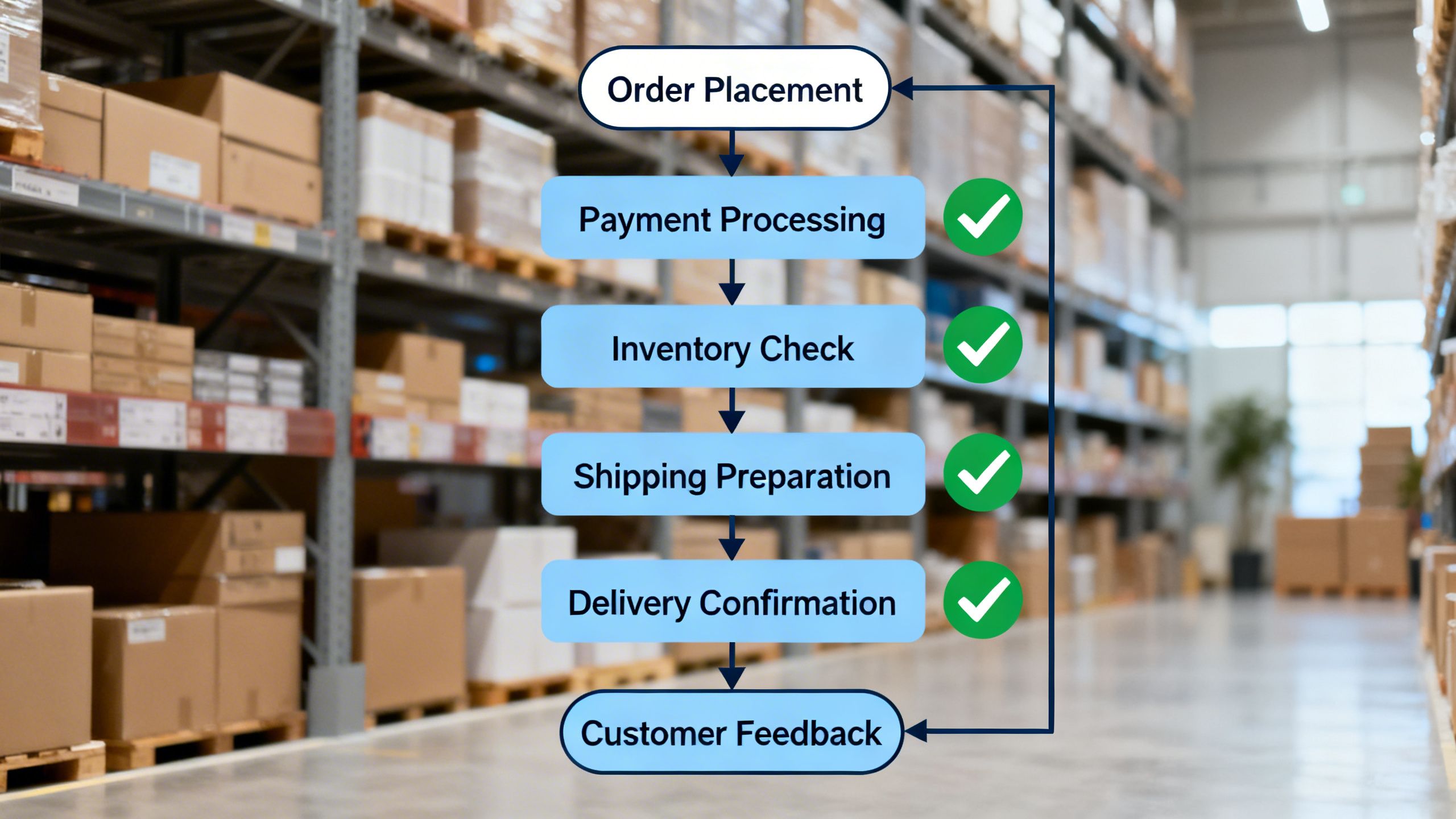
Remember our 3 AM pricing disaster? That's a system reliability failure. These glitches happen in complex systems where different components interact in unexpected ways. Automated Reasoning is designed to find these edge cases before they find your customers.
It can be used to verify the logic of your most critical workflows:
- Pricing Engines: Prove that your dynamic pricing rules can never result in a price below a certain floor or create an exploitable loophole.
- Inventory Sync: Verify that the logic for updating stock levels across multiple channels (e.g., Amazon, Shopify, Walmart) is sound and won't lead to overselling.
- Checkout Process: Formally check that every possible path a user can take through checkout leads to a valid outcome, without getting stuck or losing data.
Putting Automated Reasoning to Work: A Practical Guide
You don't need to hire a team of logicians to benefit from AR. The key is to adopt the mindset and leverage tools that have these principles built-in.
Step 1: Identify Your 'Cannot Fail' Systems
Start by mapping out your business processes and identifying the ones where an error would be most costly. This isn't about boiling the ocean; it's about strategic risk mitigation. Your list will likely include:
- Payment Processing: The flow of money is non-negotiable.
- Customer Data Management: Security and privacy are paramount.
- Core Inventory Logic: Overselling and stockouts kill profits and rankings.
- Promotional and Coupon Engines: A buggy coupon can wipe out your margins.
These are the areas where a little extra logical rigor goes a long way.
Step 2: Leverage 'Verification-Aware' Tools and Platforms
The good news is that you don't have to build these systems yourself. The next generation of eCommerce tools is being built on a foundation of trust and verification. When evaluating software, especially AI-powered analytics, ask questions that get to the heart of reliability.
Key Tip: Instead of asking an AI platform what it knows, ask it how it knows. A trustworthy platform should be able to trace its conclusions back to the source data. Platforms like TrackIQ are designed from the ground up to provide answers rooted in your actual business data, not opaque algorithms.
Step 3: Adopt the 'Least Privilege' Mindset for Data
This principle isn't just for user permissions; it's for your data, too. An AI tool doesn't need to know everything about your business to answer a specific question. Over-feeding an AI with irrelevant data can lead to confusing or incorrect outputs—a problem known as