Your eCommerce Store is Leaking Money: How AI Anomaly Detection Plugs the Holes

Quick Summary (TL;DR)
• Find Hidden Fires: Anomaly detection is your business's 24/7 watchdog, automatically spotting costly issues like pricing errors, stockouts, and ad spend waste before they escalate.
• The Old Way is Broken: Manually checking spreadsheets is slow, reactive, and impossible to scale. You're guaranteed to miss critical, money-draining problems.
• AI is Your Co-Pilot: Modern AI systems use ensemble models to analyze your live data, adapt to your business's unique patterns, and flag true anomalies without drowning you in false alarms.
—
It’s 3 AM. You’re asleep, but your business isn’t. A pricing rule you set last week just misfired, and your top-selling product is now selling for $1.99 instead of $19.99. By the time you wake up, you’ve sold 1,000 units at a massive loss. This isn't a nightmare; it's an anomaly, and it happens to eCommerce sellers every single day.
These silent business killers—from inventory glitches to fraudulent orders and broken ad campaigns—are nearly impossible to catch with the naked eye. You can't be everywhere at once, and staring at dashboards all day isn't a growth strategy. This is where AI-powered anomaly detection comes in. It’s not another complicated tool; it’s a fundamental shift from being reactive to proactive, giving you an automated co-pilot that guards your profits while you focus on scaling.
What Exactly is Anomaly Detection in eCommerce?
Think of anomaly detection as an incredibly smart, always-on security guard for your business data. Its only job is to watch the constant stream of information—sales, inventory, ad spend, customer reviews, website traffic—and instantly flag anything that deviates from the norm. It learns what's "normal" for your business, even during seasonal peaks and troughs, and alerts you when something is out of place.
An anomaly isn't always a negative event. A sudden, unexpected spike in sales from an influencer shoutout is also an anomaly. The key is getting the insight to know why it happened so you can react accordingly—either to fix a problem or capitalize on an opportunity.
Why This is a Must-Have, Not a Nice-to-Have
For too long, this technology was reserved for FAANG companies with armies of data scientists. Today, it's an accessible and essential tool for any serious eCommerce brand or agency. Here’s why.
Benefit #1: It Directly Protects Your Bottom Line
Your profit margin is under constant assault from a thousand tiny cuts. Anomaly detection acts as a financial shield.
- Pricing & Discount Errors: Catch a fat-finger mistake that lists a $500 item for $50 before it wipes out your inventory and profit.
- Fraudulent Activity: Identify unusual purchasing patterns, like a single user making dozens of high-value orders with different cards, indicating potential fraud.
- Ad Spend Waste: Get an alert when a campaign's cost-per-acquisition (CPA) suddenly skyrockets, allowing you to pause it before it burns through your budget.

Benefit #2: It Safeguards the Customer Experience
A poor customer experience is a silent killer of repeat business. Anomaly detection helps you find and fix issues before your customers do.
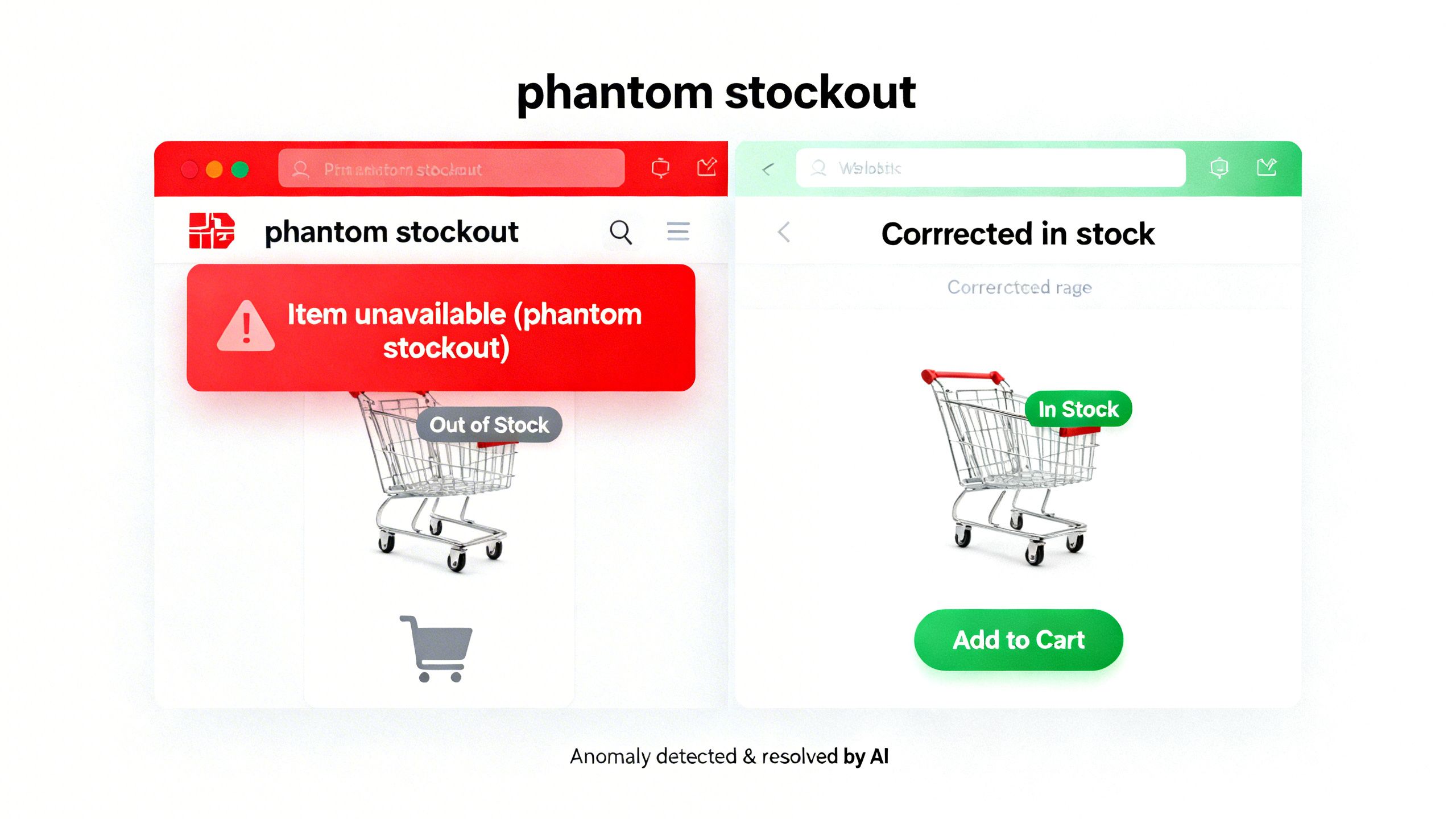
- Phantom Stockouts: Your site says an item is in stock, but your warehouse says it's not. Anomaly detection can spot the discrepancy between sales velocity and inventory data, preventing overselling and customer frustration.
- Website & Listing Errors: A broken "Add to Cart" button or a suppressed Amazon listing can tank your sales. Anomaly detection flags the sudden drop in conversion rate for a specific page or SKU, pointing you directly to the problem.
- Surges in Negative Reviews: A sudden spike in 1-star reviews for a product can indicate a bad batch or a shipping issue. Getting an early warning allows you to investigate immediately.
A Practical Guide to How Modern Anomaly Detection Works
Forget the jargon. The evolution of anomaly detection is simple: we've moved from manual spot-checks to an intelligent, automated system that works like a team of experts.
Step 1: The Old Way — Spreadsheets and Hope
The traditional method involves exporting data into spreadsheets and manually looking for weird numbers. This is slow, prone to human error, and fundamentally reactive. By the time you find the problem, the damage is already done. It’s like trying to find a single leaky pipe in a skyscraper by checking every faucet one by one.
Key Tip: If you're still spending hours every Monday morning pulling reports, you're operating in the past. Your time is better spent on strategy, not data entry.
Step 2: The New Way — The Power of an AI Committee
Modern systems, inspired by concepts like the SEAD model from recent AI research, use an ensemble approach. Instead of relying on one rigid algorithm, they deploy a committee of specialized AIs. One AI is an expert at spotting ad spend anomalies, another excels at inventory, and a third is a master of detecting pricing errors.
The system intelligently learns which "expert" to trust based on the data it's seeing. As the research paper on SEAD notes, the system rewards models that are more "reticent"—meaning they don't cry wolf and only flag high-confidence anomalies. This dramatically reduces the noise of false positives.
Key Tip: A good anomaly detection system doesn't just send alerts; it sends the right alerts. It understands the difference between a normal holiday sales spike and a true, costly error.

Step 3: Real-Time, Unsupervised Learning
The real game-changer is that these systems are unsupervised and operate in real-time.
- Unsupervised means you don't have to spend months "training" the AI by manually labeling thousands of past anomalies. It learns the unique rhythm of your business on its own.
- Real-time means it processes data as it happens. It catches that pricing error at 3:01 AM, not 9:00 AM the next day.
This creates a system that adapts dynamically. If a new marketing campaign causes a shift in your sales patterns, the AI learns this new normal instead of incorrectly flagging it as an anomaly.
Anomaly Detection: Real-World eCommerce Scenarios
Theory is great, but let's talk about real money. Here’s how this plays out in practice.
The Phantom Stockout: A Silent Sales Killer
- Challenge: A popular product suddenly stops selling, but your inventory system shows thousands of units in stock. Unbeknownst to you, a sync error has made the product appear as "out of stock" on your storefront.
- Anomaly Detected: The AI flags a sharp deviation:
Sales Velocity = 0despiteInventory > 0andAd Spend > 0for that SKU. - Solution: You get an alert pinpointing the exact product. Instead of discovering this days later after losing thousands in sales, you fix the sync error within minutes and sales resume.
The Rogue Ad Campaign: The Budget Burner
- Challenge: An A/B test on an ad creative goes wrong. The losing variant is accidentally scaled up, burning hundreds of dollars per hour with a near-zero conversion rate.
- Anomaly Detected: The system flags a critical mismatch:
Ad Spendfor Campaign XYZ is spiking, whileRevenueandConversion Ratefrom that campaign are flatlining. - Solution: You're notified of the inefficient campaign and can pause it immediately, saving potentially thousands of dollars in wasted ad spend.
Common Pitfalls to Avoid
Implementing anomaly detection isn't just about buying a tool. It's about adopting a new workflow. Here are two mistakes to avoid.
Mistake #1: Drowning in Data (Analysis Paralysis)
Many tools are great at flagging problems but terrible at telling you what to do about them. You get an alert that says, "Revenue for SKU-123 is down 40%." Is it a pricing issue? A stockout? A new competitor? An avalanche of alerts without context is just more noise.
This is why the future of AI in eCommerce is an agentic AI co-pilot that provides solutions, not just data. A great system doesn't just tell you what happened; it investigates why and suggests the next step.
Mistake #2: Using a Rigid, Rule-Based System
Setting manual rules like "alert me if sales drop by more than 20%" is brittle and outdated. A 20% drop on a Tuesday afternoon is very different from a 20% drop on Black Friday. These systems lead to a constant stream of false alarms, which eventually causes you to ignore all alerts entirely.
Modern, adaptive AI learns your business's natural ebbs and flows, so when it sends an alert, you know it matters.
Why TrackIQ Matters: From Anomaly Detection to Automated Action
This entire philosophy of proactive, intelligent, and actionable monitoring is the bedrock of TrackIQ. We built our platform not just to show you dashboards, but to serve as a true co-pilot for your eCommerce business.
TrackIQ's AI-powered platform connects directly to your Amazon data and acts as your 24/7 analyst. It uses the advanced, adaptive principles we've discussed to:
- Monitor Hundreds of Metrics: It watches everything from sales and inventory to ad performance and Buy Box percentage, so you don't have to.
- Surface Actionable Insights: When it detects an anomaly—like a sudden drop in your Buy Box win rate for a key product—it doesn't just send a vague alert. It tells you what's happening and why, allowing you to take immediate, informed action.
- Learn Your Business: TrackIQ is designed to be an expert in your business. It learns your sales cycles, your inventory turn, and your advertising patterns to deliver insights that are uniquely relevant to you.
Conclusion: Stop Reacting, Start Winning
Running a successful eCommerce business in today's market is about speed and efficiency. You can no longer afford to be reactive, putting out fires long after they've started causing damage.
Here are the key takeaways:
- Embrace Proactive Monitoring: Stop waiting for problems to show up in weekly reports. Use AI to catch them in real-time.
- Focus on Action, Not Just Alerts: Choose tools that provide context and solutions, not just more data points to analyze.
- Automate the Grunt Work: Let AI handle the tedious work of monitoring your business data, freeing you up to focus on high-level strategy, marketing, and growth.
By implementing AI-powered anomaly detection, you're not just buying a piece of software; you're buying peace of mind and a powerful competitive advantage. You're ensuring that while you sleep, someone—or something—is always watching over your business, protecting your profits and your customers.
—