The Unspoken Rules of Amazon KDP: How to Actually Make Money in 2026

Quick Summary (TL;DR)
• KDP Is a System, Not a Lottery: Success on Amazon Kindle Direct Publishing isn't about luck. It's about understanding the algorithm, mastering royalties, and building a catalog. Most authors fail because they treat it like a one-time event.
• Royalties Are Deceivingly Complex: The difference between a 70% and 35% royalty isn't just a button click. Pricing, file size, and international markets can quietly drain your earnings without you ever noticing.
• Data Beats Guesswork, Every Time: The authors who win on KDP don't just write well; they analyze the market. Using tools to understand keywords, competition, and reader behavior before you publish is the ultimate cheat code.
—
Ever poured your soul into a book, hit “publish” on Amazon Kindle Direct Publishing (KDP), and then… crickets? You’re not alone. Every single day, thousands of authors upload their masterpieces, only to see them vanish into the digital abyss, buried under a mountain of other titles. It’s a brutal, soul-crushing feeling.
Most of these books don’t fail because the writing is bad. They fail because the author played a game without knowing the rules. They didn’t understand how Amazon’s algorithm thinks, why a $2.99 price might earn less than $4.99, or how a simple keyword choice could make or break their launch.
This isn’t another boring guide repeating what KDP is. This is the playbook for how it actually works in 2026. We’re going to pull back the curtain on discoverability, royalties, and the strategies that turn a single book into a compounding asset. Forget what you think you know. It's time to learn the unspoken rules.
What is Amazon Kindle Direct Publishing, Really?
On the surface, Amazon KDP is a self-publishing platform. It lets you upload a manuscript, design a cover, set a price, and sell to millions of readers worldwide. Simple, right? But thinking of KDP as just an upload tool is like thinking of a chessboard as just a piece of wood. You're missing the entire game.
KDP is a complex ecosystem with its own logic, incentives, and traps. It’s a marketplace where Amazon’s primary goal is to keep readers on its platform and buying more stuff. Your book is just a vehicle for that goal. When you understand this, everything changes. You stop asking, “How can I sell my book?” and start asking, “How can I make my book the best possible product for Amazon’s algorithm to sell?”
This ecosystem gives you unprecedented control—no gatekeepers, no agents telling you to change your ending. But it also demands that you think like a publisher, a marketer, and a data analyst. The authors who succeed aren't just writers; they're entrepreneurs.
Why KDP is Still a Goldmine (If You Have the Right Map)
Despite the competition, KDP remains one of the greatest opportunities for creators today. But you have to know where to dig.
Total Control: You're the CEO of Your Book
Traditional publishing means giving up control. You lose say over your cover, your pricing, and your marketing. With KDP, you are the boss. You decide everything. This isn't just about creative freedom; it's about business agility. See a new trend emerging? You can write and publish a book in weeks, not years. Is a cover not performing? You can swap it out tomorrow.
This level of control is a superpower. It allows you to test, iterate, and respond to the market in real-time—something traditional publishers can only dream of.

The Data Feedback Loop: Learn and Earn Faster
In the old world, you'd wait six months to a year for a royalty statement. On KDP, you get data daily and payments monthly. This creates an incredibly tight feedback loop. You can see which ads are working, how a price change affects sales, and which books in your series are driving the most read-through.
This isn't just about money; it's about learning. Every sale, every page read in Kindle Unlimited, is a data point telling you what readers want. The faster you learn, the faster you can give them more of it. This is how you build a career, not just launch a book.
The KDP Launch Playbook: From Manuscript to Marketplace
Alright, let's get tactical. Publishing on KDP involves a few key steps, but the devil is in the details. Here’s how to do it right.
Step 1: Setting Up Your Command Center: Account & Tax Essentials
This is the boring but critical part. Before you do anything else, get your KDP account set up perfectly. Sign in with your Amazon account, enable two-step verification, and immediately fill out your tax and banking information.
Key Tip: If you’re outside the U.S., fill out the W-8BEN form immediately. This is the single most common reason for payment delays and incorrect tax withholding. Don't let paperwork hold up your money.
Step 2: Forging Your Weapon: Manuscript Prep & Formatting
Your manuscript is your product. Treat it like one. The flow should always be: Write → Edit → Format. Never format before you’ve had your book professionally edited (or at least torn apart by beta readers you trust).
For formatting, use tools designed for the job. KDP’s own Kindle Create is free and works well. Other popular options include Vellum (Mac-only, but the gold standard) and Atticus (cross-platform). These tools export clean EPUB or KPF files that look great on any device.
Key Tip: Always, always use the Kindle Previewer tool to see how your book looks on different devices, from a phone to a large tablet. A formatting error on page one is a great way to earn a 1-star review.
Step 3: The First Impression: Designing a Cover That Clicks
Your book cover is not art. It’s a billboard. It has one job: to make a reader in your target genre click. It needs to look professional and instantly signal what the book is about, even as a tiny thumbnail on a phone screen.
Unless you are a professional designer, do not design your own cover. Hire someone on a site like 99designs or Reedsy who specializes in your genre. Look at the top 100 bestsellers in your category. Your cover should look like it belongs there.
Amazon KDP Royalties: The Hidden Money Leaks
Here’s where most new authors lose their shirts. The royalty system seems simple: choose 35% or 70%. But it’s a minefield of exceptions and hidden costs that can decimate your earnings.
The 70% Royalty Trap
Everyone wants the 70% royalty rate, but to get it, your eBook must be priced between $2.99 and $9.99. Price it at $2.98 or $10.00, and you’re automatically bumped down to 35%. But here's the kicker: with the 70% option, Amazon charges you a “delivery fee” based on your file size. A book loaded with high-res images can have a delivery fee so large that you actually earn less at 70% than you would at 35%.
Example: A large, image-heavy book priced at $3.99 might net you $2.00 at a 70% royalty after fees. The same book at 35% would net you $1.40 with no fees. The difference shrinks fast.
The International Royalty Maze
Your book is sold globally, but your price isn't. Amazon converts your USD price for other marketplaces, and those conversions can sometimes push your book outside the 70% royalty band in a specific country. You might be earning 70% in the US but only 35% in the UK or Germany without even realizing it. You have to manually check and set prices for each major market to ensure you’re optimized everywhere.
Why TrackIQ Matters: Navigating the KDP Jungle with AI
So how do you manage all this? The pricing maze, the keyword research, the competitor tracking? You could spend hours buried in spreadsheets… or you could use an AI-powered copilot. This is where a platform like TrackIQ becomes an author's secret weapon.
Historically, this kind of business intelligence was complex and expensive. But modern tools are changing the game. Instead of guessing which keywords to use, you can analyze what’s actually driving sales in your niche. Instead of setting prices based on a gut feeling, you can model how different price points will impact your royalties across all markets. This is how you free up human capital for strategic work—like writing your next book.
From Guesswork to Guaranteed Hits: Using AI for Keyword Intelligence
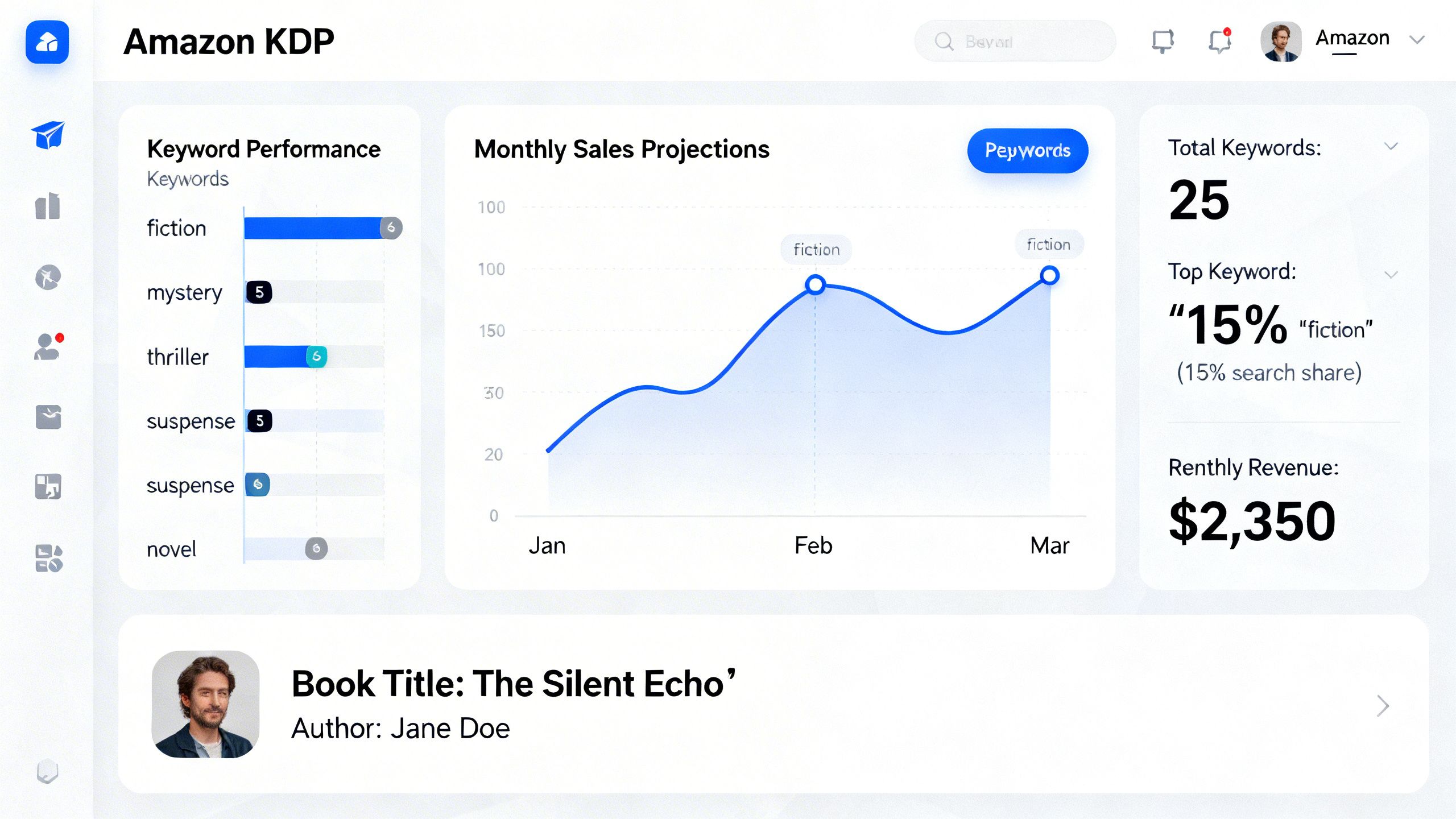
Success on KDP is about discoverability. If readers can't find you, they can't buy from you. TrackIQ helps you uncover the high-traffic, low-competition keywords that readers are using to find books just like yours. It’s like having a map of the treasure before you even start digging. This is the core of the conversational AI advantage that simplifies eCommerce analytics. You just ask questions and get answers based on real market data.
Beyond the Dashboard: Uncovering Hidden Royalty Opportunities
Remember the international royalty maze? An agentic AI system can monitor your sales and pricing across all 13 Amazon marketplaces, alerting you to opportunities. It might find that your book is selling surprisingly well in Australia, and suggest a localized price adjustment that could boost your earnings by 15%. This is the kind of insight that separates amateur sellers from professional publishers. You can see how it works to turn raw data into actionable strategy.
Common KDP Mistakes That Silently Kill Your Book
Avoid these common, career-ending mistakes.
The 'One and Done' Fallacy
Publishing one book and hoping it becomes a bestseller is like buying a single lottery ticket and expecting to win. It almost never happens. The algorithm favors authors with a catalog. Each book you publish teaches Amazon more about who your audience is, making it easier for them to sell your next book. The first book is often just a data point.
Ignoring Amazon Ads Data
Most authors run Amazon Ads, see a negative return, and quit. Big mistake. The primary goal of ads, especially for a new book, isn't immediate profit—it's data. Ads are the fastest way to teach Amazon who your book is for. The search term report is a goldmine, showing you exactly what readers typed before buying your book. This is invaluable data you can use to optimize your keywords, description, and even the topic of your next book.
Advanced KDP Tactics: Playing the Long Game
Once you've mastered the basics, it's time to think bigger.
- Build a Series: This is the single most powerful strategy on KDP. A series dramatically increases read-through and lifetime customer value. Readers who love book one will often buy the entire series. This creates a stable, predictable income stream that a standalone book can't match.
- Master the Backlist: Your older books are assets. Run periodic promotions on book one of a series to attract new readers into your ecosystem. A well-maintained backlist can generate more income than a new launch.
- Go Multi-Format: Don't just stop at eBooks. Use KDP's print-on-demand for paperbacks and hardcovers. Expand into audiobooks via ACX. Each format reaches a different segment of the market and reinforces the others, making your book look more established and professional in Amazon's eyes.

Your KDP Blueprint for Success
Let's boil it all down. The path to success on Amazon Kindle Direct Publishing isn't a secret, but it requires a shift in mindset.
- Think Like a Publisher, Not Just a Writer: Your book is a product. Treat it as such. Invest in professional editing and cover design. Understand your market and your customer.
- Embrace the Data: Don't guess. Use the data from your sales, your ads, and tools like TrackIQ to make informed decisions about pricing, keywords, and marketing.
- Play the Long Game: Success on KDP is a marathon, not a sprint. Build a catalog of books, cultivate a readership, and focus on creating a sustainable author business.
Conclusion
Amazon KDP has leveled the playing field, giving anyone the chance to become a published author. But with great opportunity comes great competition. Simply writing a good book is no longer enough. The authors who thrive in 2026 and beyond are those who combine creativity with strategy, art with analytics.
They understand that they are running a small business, and they use every tool at their disposal to gain an edge. By understanding the unspoken rules of the KDP ecosystem and leveraging powerful AI tools like TrackIQ, you can stop gambling and start building a predictable, profitable author career. The platform is waiting. It's time to play the game to win.
—