The Silent Profit Killer: A Seller's Guide to AI-Powered Visual Defect Detection

Quick Summary (TL;DR)
• Hidden Costs are Brutal: Shipping damaged or defective products quietly drains your profits through returns, negative reviews, and wasted inventory. It's a bigger problem than most sellers realize.
• AI is the New Watchdog: Inspired by giants like Amazon, AI-powered visual defect detection is no longer sci-fi. It uses cameras and algorithms to spot flaws humans miss, from tiny creases to major damage, before an item ever leaves your warehouse.
• You Can Start Now: You don't need a million-dollar budget to begin. Implementing basic data collection and exploring entry-level tech can give you a massive competitive edge, reduce waste, and protect your brand reputation.
—
Ever had that sinking feeling when you see a return notification? You check the reason: "Arrived Damaged." It’s not just the lost sale; it’s the return shipping cost, the unsellable inventory, the potential 1-star review, and the nagging thought: how many more of these are out there? For eCommerce sellers and agencies, this isn't a rare occurrence—it's a constant, low-grade fever that slowly eats away at your profit margins. It’s a silent killer.
But what if you could catch nearly every defect before it was boxed and shipped? What if you had a superhuman inspector on your line, working 24/7, with eyes that could spot a misprint on a label or a slight tear in a box from ten feet away? That's the promise of visual defect detection, a field being revolutionized by artificial intelligence. Big players are already all-in. Amazon just released a massive dataset called "Kaputt" to train AI on this exact problem, highlighting the shift from manual checks to automated, intelligent quality control. This guide will break down what AI-powered visual defect detection is, why it's about to become essential for every seller, and how you can start using it to protect your profits and delight your customers.
What Exactly is Visual Defect Detection?
In simple terms, visual defect detection is the process of using technology—primarily cameras and smart software—to automatically identify physical flaws, damage, or imperfections on products. Think of it as a digital quality control inspector. Instead of relying solely on the human eye, which gets tired and can be inconsistent, this automated approach uses AI models trained on thousands of images to learn what a "perfect" product looks like.
When a new item passes the camera, the AI compares it to its reference and instantly flags anything that doesn't match, whether it's a crushed corner, a leaking bottle, a missing part, or incorrect labeling. The goal is to catch these issues early in the logistics chain, saving immense costs and preventing a poor customer experience.
Why This Is a Game-Changer for Your eCommerce Business
Implementing this technology isn't just about finding a few broken items. It's a strategic move that impacts your entire operation, from your bottom line to your brand's public image.
Benefit 1: Drastically Reduce Returns and Refund Costs
Every damaged item that reaches a customer is a guaranteed loss. You lose the cost of the product, the outbound shipping, the return shipping, and the labor involved in processing it. These costs add up with terrifying speed. By catching defects at the source, you turn a guaranteed loss into a manageable inventory issue. Instead of paying to ship a broken item across the country and back, you simply set it aside.

According to Amazon's own research on their new Kaputt dataset, the variety and subtlety of defects in a real-world logistics environment are far more complex than in controlled manufacturing settings. This highlights how many flawed products are likely slipping through traditional quality checks.
Benefit 2: Safeguard Your Brand Reputation and Customer Trust
In the age of social media and instant reviews, a single bad experience can have an outsized impact. Receiving a damaged product feels personal; it tells the customer you don't care about their experience. This leads to scathing reviews, negative word-of-mouth, and long-term brand erosion.
Conversely, consistently delivering products in perfect condition builds immense trust and loyalty. AI agents are coming for your eCommerce stack, and quality control is one of the first frontiers. An automated system ensures that every customer gets the best version of your brand, every single time.

A Seller's Playbook: How to Get Started with Visual Defect Detection
You don't need to be Amazon to start reaping the benefits. The key is to begin with a smart, scalable approach. Here’s a step-by-step guide for sellers and agencies.
Step 1: Become a Data Detective
Before you can automate, you need to understand the problem. Start by manually tracking and documenting defects for a few weeks.
- Set up a dedicated station: Have your packing team set aside any item with a flaw.
- Photograph everything: Take clear, well-lit photos of the defects. Note the product (ASIN), the type of damage, and where you think it occurred (e.g., from supplier, in warehouse).
- Create a simple log: Use a spreadsheet to track this data. This initial dataset is your goldmine. It will reveal your most common problems and provide a baseline for any future system.
Key Tip: This manual process isn't just about data collection; it trains your team to develop a sharper eye for quality, immediately improving your standards.
Step 2: Define Your Defect Bible
What one person considers a "minor scratch," a customer might see as "unacceptable damage." You need to create a clear, visual guide that defines what constitutes a defect for your business. Categorize defects by severity (e.g., Minor, Major, Critical) and type (e.g., Crushed, Torn, Leaking, Scratched). This removes subjectivity and ensures everyone—from your warehouse team to a future AI—is working from the same rulebook.
Key Tip: Use the photos from Step 1 to build this guide. A visual reference is a thousand times more effective than a text description. This is exactly what Amazon did to build its Kaputt dataset, using reference images to define what's normal vs. defective.
Step 3: Explore Entry-Level Technology
Once you have your data and definitions, you can explore technology. You don't have to build a complex AI from scratch. Start small.
- Camera Setups: A simple, fixed HD webcam or even a modern smartphone mounted over your packing station can be a great starting point for capturing images of every item before it's packed.
- Reference Image Software: Look for simple software that allows an operator to quickly compare a live image to a "golden sample" reference image on a screen. This semi-automated approach can significantly increase accuracy.
Visual Defect Detection: From Lab to Logistics
The theory is great, but what does this look like in the real world? The applications are already taking shape, driven by cutting-edge research.
Specific Practice: Learning from Amazon's "Kaputt" Benchmark
Amazon's recent announcement of the Kaputt dataset is a peek into the future. They compiled over 238,000 images to teach AI how to spot defects in a chaotic retail environment. The results were telling: even the most advanced, general-purpose AI models were barely better than a coin flip at spotting defects without specific training. However, supervised models trained on the dataset achieved over 94% accuracy.
This tells us that contextual data is everything. An AI for detecting flaws in electronics is different from one for apparel. The future of agentic AI in eCommerce lies in these specialized, highly trained systems.
Specific Practice: Beyond the Box—Detecting Granular Flaws
Visual defect detection isn't just about crushed shipping boxes. It can be trained for highly specific tasks:
- Apparel: Spotting incorrect stitches, fabric pulls, or stains.
- Cosmetics: Identifying cracked containers, misaligned labels, or incorrect shades.
- Electronics: Detecting fine scratches on screens or missing accessory components in the box.
- Groceries: Flagging bruised fruit or leaking packages in a grocery delivery service.
Why TrackIQ Matters: Connecting Defects to Dollars
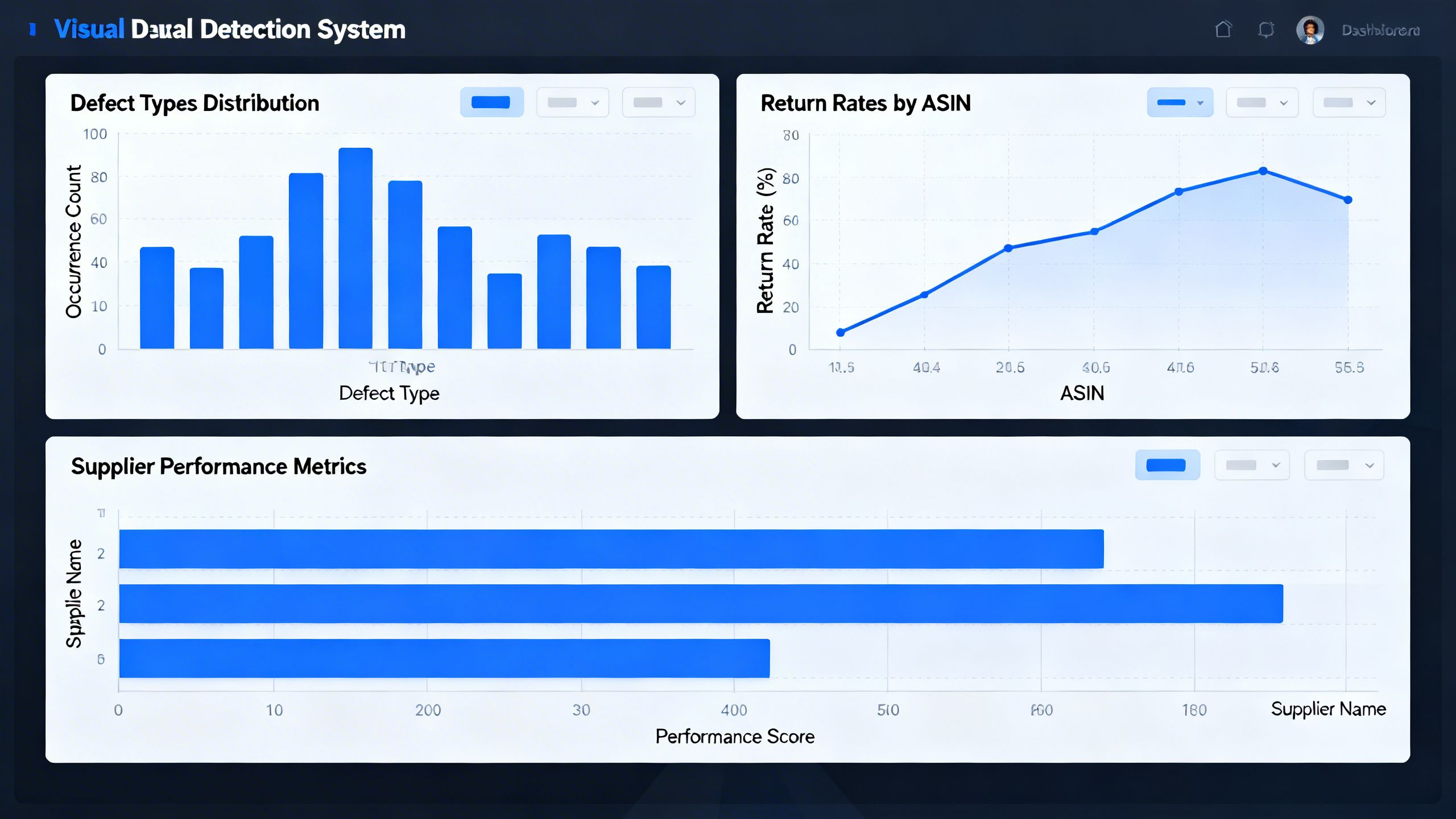
Spotting a defect is only half the battle. The real question is: what is this defect costing me? This is where visual inspection data needs to connect with your business analytics. A standalone defect detection system is a tool; integrating it with a powerful analytics platform turns it into a profit-driving strategy.
This is where a platform like TrackIQ becomes invaluable. While your camera system flags a damaged item, TrackIQ can answer the crucial follow-up questions:
- Is this defect type correlated with a spike in returns for a specific ASIN?
- Are defects more common from a particular supplier or a specific batch of inventory?
- What is the total financial impact of "minor" box damage over the last quarter?
By asking simple questions in plain English, you can use TrackIQ's AI agent to connect your operational data (like defects) to your financial data (like returns and profit margins). It bridges the gap between seeing a problem on the warehouse floor and understanding its impact on your P&L, allowing you to make strategic decisions, not just reactive fixes.
Common Pitfalls to Avoid on Your QC Journey
As you venture into automated quality control, steer clear of these common mistakes that can derail your progress.
Specific Pitfall: Chasing Perfection and Ignoring Good Enough
Many sellers get stuck trying to find a perfect, all-in-one, 100% accurate system from day one. They spend months researching and never start. The reality is that even a system that catches 50% more defects than your current manual process is a huge win. Start with a simple, "good enough" solution and iterate. Don't let the pursuit of perfection be the enemy of progress.
Specific Pitfall: Garbage In, Garbage Out (Poor Setup)
An AI is only as good as the images it sees. The most common failure point for visual detection systems is a poor physical setup. Inconsistent lighting creates shadows that can be mistaken for defects. A camera that's out of focus or at the wrong angle will miss details. Ensure your inspection station has bright, diffuse, consistent lighting and that your camera is securely mounted to capture a clear, repeatable view of every product.
Advanced Tactics: The Future of Automated Quality Control
Once you've mastered the basics, you can move toward a truly intelligent and predictive system.
- Integration with WMS: Connect your detection system directly to your Warehouse Management System. When a defect is flagged, the system can automatically quarantine the item, update inventory levels, and even trigger a re-order if stock is low.
- Predictive Analytics: As you build a large dataset of defect information, you can use AI to move from detection to prediction. The system can learn to identify patterns, such as a specific product being 30% more likely to have defects when it arrives from a certain supplier on a Monday. This allows you to proactively inspect high-risk inventory.
- Closing the Loop with Suppliers: Share your defect data with your suppliers. Clear, photographic evidence of recurring quality issues is a powerful tool for negotiating credits, improving packaging standards, and holding partners accountable.
Conclusion: Your First Step Towards Flawless Fulfillment
The era of relying on overworked human eyes to guard your brand's reputation is coming to an end. AI-powered visual defect detection is rapidly moving from a futuristic concept to an essential tool for any serious eCommerce seller. It's your best defense against the silent profit killer of returns, a powerful way to build customer trust, and a cornerstone of an efficient, data-driven operation.
Don't wait for your return rate to force your hand. Start today by simply observing and documenting the quality issues in your own fulfillment process. By taking small, deliberate steps, you can build a formidable quality control system that protects your bottom line and ensures every customer receives the perfect product you intended to sell.
Ready to connect your operational data to your profit margins? Explore how TrackIQ's conversational AI can help you make smarter, data-backed decisions to grow your business.