The AI Speed Trap: Why Faster, Not Bigger, AI for eCommerce is the Real Game-Changer

Quick Summary (TL;DR)
• Bigger Isn't Better: The race for massive AI models is a distraction. For eCommerce, speed and efficiency deliver real value, not the number of parameters.
• From Analyst to Agent: The best AI for eCommerce doesn't just show you data; it takes action. These "AI agents" are your new co-pilots for tasks like ad spend and inventory management.
• Time is Money (Literally): A slow insight is a lost sale. Time-efficient AI provides answers when they matter, turning data into immediate, profitable decisions.
• Focus on the Job-to-be-Done: Stop chasing shiny objects. The most effective AI tools are specialized, or "pruned," to solve specific eCommerce challenges with surgical precision.
—
Remember the first time you saw an AI create a stunning image from a one-sentence prompt? Or write a poem that actually sounded... good? It felt like magic. The tech world became obsessed with a simple equation: bigger model = better AI. We were told that intelligence was all about parameter counts, and soon, we’d have digital brains the size of planets solving all our problems.
It’s a great story. But if you’re running an eCommerce business, it’s the wrong story.
You don’t need an AI that can write a Shakespearean sonnet about your best-selling garlic press. You need an AI that tells you to reorder that garlic press before it stocks out during the holiday rush. You need an AI that automatically shifts your ad budget from a failing campaign to a profitable one at 3 AM. For eCommerce sellers, the true measure of AI intelligence isn't size; it's speed-to-insight.
This is the new frontier of AI for eCommerce: a shift away from bloated, slow, general-purpose models toward lean, fast, and actionable AI agents. It’s about getting the right answer, right now. Let's talk about why this changes everything.

What is Time-Efficient AI, Anyway?
Let's ditch the jargon. Think of it like this: a massive, general-purpose AI is like a library containing every book ever written. If you ask it a question, it can find the answer, but it might have to wander through miles of shelves, cross-reference a dozen encyclopedias, and get back to you next Tuesday. It’s powerful, but slow and unfocused.
Time-efficient AI, on the other hand, is like having a world-class expert on speed dial. This expert has read all the relevant books, thrown out the fluff, and can give you a clear, actionable answer in seconds. This is the core of what scientists call transductive learning—reasoning through data to craft a solution for a specific problem, rather than just generalizing from the past.
In eCommerce, a correct answer delivered too late is the same as a wrong answer. The goal isn't to know everything; it's to know the right thing at the right time.
This is the difference between an AI that acts like a passive analyst and one that performs like an active co-pilot. It's the difference between a data dump and a decision.
Why Speed and Context Matter More Than Size in eCommerce
The obsession with model size leads to what Amazon scientists call the "savant regime"—an AI that can memorize and recite vast amounts of data but has zero insight. It's a brute-force approach, not an intelligent one. For an eCommerce operator, that's not just unhelpful; it's dangerous.
The High Cost of a Slow 'Aha!' Moment
In a recent paper, AI researchers used a brilliant analogy: a zebra at a watering hole. It doesn't know when a predator might show up. If it lingers too long, it gets eaten. If it panics and leaves too early, it dies of thirst. The zebra has to make a time-sensitive decision based on incomplete information.

Sound familiar? As a seller, you're that zebra. The predator is a stockout, a price war, a sudden spike in ad costs, or a competitor snatching the Buy Box. A time-efficient AI for eCommerce is your lookout. It spots the threat and tells you to move now, while a 'savant' AI is still calculating the exact probability of a lion attack to ten decimal places.
Avoiding the 'Shiny Object' Syndrome
Many sellers fall into the trap of buying complex, expensive AI systems that promise the world. They get mesmerized by flashy demos and buzzwords, only to end up with a tool that's too complicated to use or, worse, just spits out more data to analyze. This is the classic 'shiny object' syndrome.
The solution is to focus on AI that is purpose-built. As we've discussed before, the most effective AI tools are often the ones that have been 'pruned' to be faster, smarter, and cheaper. They're designed to do one thing exceptionally well, whether it's managing ad spend, forecasting inventory, or optimizing listings.
A Practical Guide to Implementing Smart AI for eCommerce
So, how do you move from theory to practice? It's not about hiring a team of data scientists. It's about taking a structured approach to automation.
Step 1: Identify Your Biggest Time Sinks
Before you even look at an AI tool, open a spreadsheet. For one week, track every repetitive, manual task you do. Is it:
- Pulling daily sales and ad reports?
- Manually checking inventory levels across 50 SKUs?
- Adjusting bids on your PPC campaigns every morning?
- Trying to figure out why your profit margin on a specific product suddenly dropped?
These tasks are the prime candidates for an AI agent to take over. They are structured, data-driven, and time-consuming—the perfect job for a robot co-pilot.
Key Tip: Don't try to boil the ocean. Pick the one task that causes you the most pain or takes the most time. That's your starting point.
Step 2: Choose a Scalpel, Not a Swiss Army Knife
Now that you know the problem, look for the right tool. Resist the urge to get a generic AI chatbot and try to teach it eCommerce. Instead, look for platforms that are already experts. You're looking for Agentic AI—systems that don't just answer questions but can perform multi-step tasks on your behalf.
These are systems designed with eCommerce logic built-in. They already understand concepts like ASINs, ACoS, inventory velocity, and profit margins. This is the key to getting immediate value. As we've explored, these systems act as your new eCommerce co-pilot, not just another dashboard.
Key Tip: Ask vendors one question: "Does your AI do things, or does it just show me things?" You want a doer.
Step 3: Start with a Conversation
The best modern AI tools operate conversationally. You shouldn't need to learn a new interface or write code. You should be able to ask questions in plain English, like:
- "Which of my campaigns have the highest ACoS this week?"
- "How many units of my top-selling product should I reorder to have 60 days of stock?"
- "Summarize my business performance from yesterday."
The AI should not only provide the answer but also suggest the next logical action. That's how you build trust and gradually hand over more complex tasks.
AI for eCommerce in Action: From Data to Dollars
Let's make this concrete. Here’s how time-efficient, agentic AI works in the real world.

Scenario 1: The Ad Spend Automator
- Challenge: You're running 30 different PPC campaigns. Some are profitable, some are burning cash. You spend an hour every morning trying to figure out which bids to raise, which to lower, and which keywords to kill.
- Agentic AI Solution: An AI agent monitors your ad performance 24/7. It detects that a specific keyword's conversion rate has dropped while its cost-per-click has spiked. It automatically pauses that keyword and reallocates the budget to a different, high-performing campaign. It then sends you a simple summary: "I moved $50 from Campaign A to Campaign B. Expected to increase daily profit by $15."
- Result: You saved an hour of work, stopped wasting money on a bad campaign, and increased your profitability—all while you were sleeping.
Scenario 2: The Inventory Co-Pilot
- Challenge: You sell seasonal products. Last year, you stocked out of your best-seller a week before the peak, losing thousands in sales. This year, you're terrified of it happening again, so you're thinking of over-ordering, which would kill your cash flow.
- Agentic AI Solution: The AI analyzes last year's sales data, current sales velocity, and even factors in your planned ad spend. It tells you, "To maintain 45 days of stock through the peak, you need to order 1,250 units by Tuesday." It can even draft the purchase order for you.
- Result: You order the right amount of stock with confidence, maximizing sales without tying up unnecessary capital.
Why TrackIQ Matters: From Insights to Action
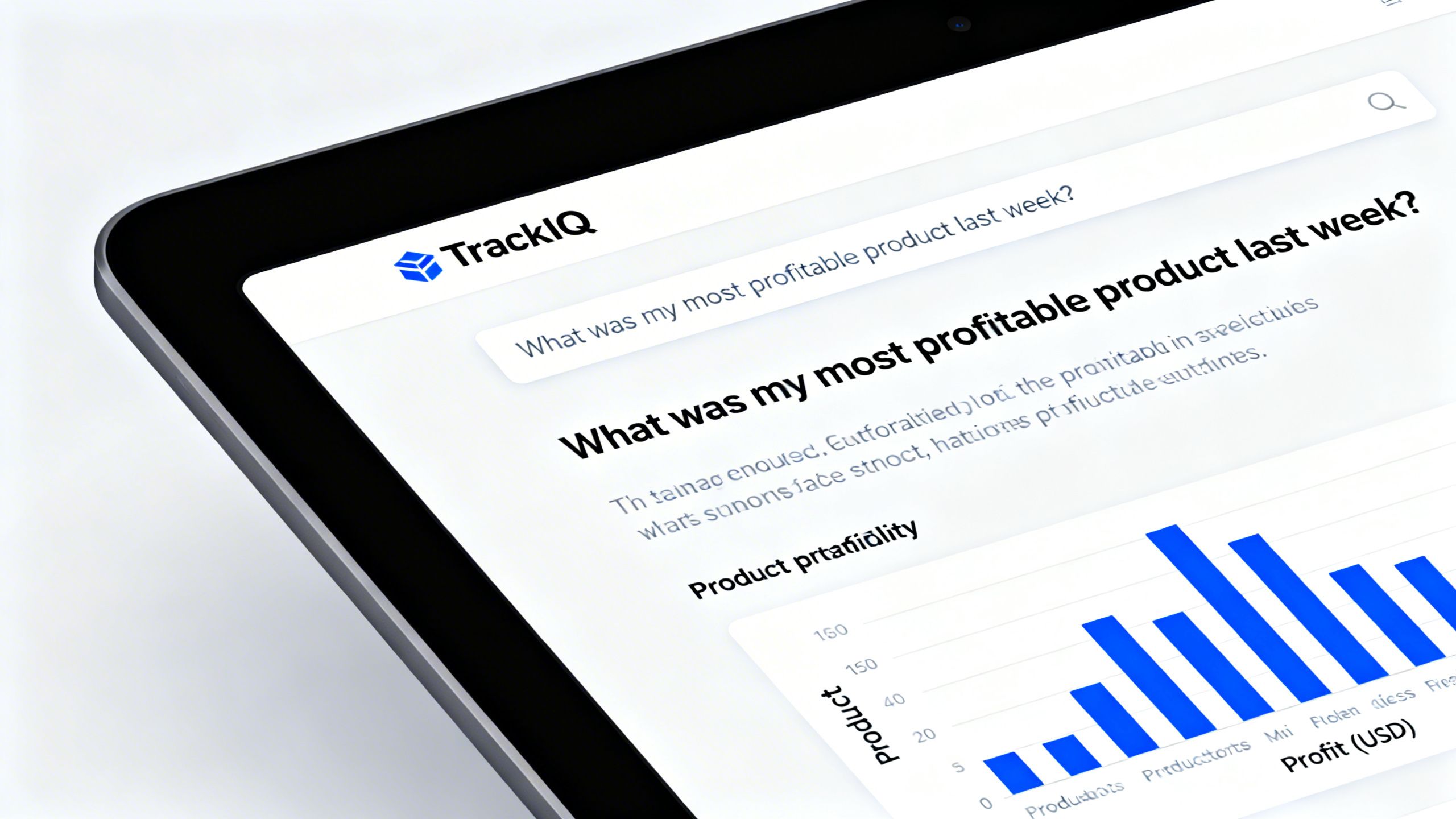
This philosophy of fast, actionable, agentic AI is the foundation of TrackIQ. We believe the purpose of AI isn't to overwhelm you with data but to provide clear, immediate answers to your most pressing questions.
Our platform was built to be the expert on speed dial. It's not a generic LLM; it's a sophisticated system trained specifically on the language and logic of eCommerce. It connects directly to your Amazon data, so it's not guessing—it's reasoning with your actual numbers.
When you ask TrackIQ a question, you're not just getting a data point. You're starting a conversation with an AI co-pilot that can:
- Diagnose Problems: Go beyond what happened to explain why it happened.
- Automate Reports: Deliver the key metrics you need, when you need them, without you having to build a single report.
- Surface Opportunities: Proactively find insights you didn't even know to look for.
It’s designed to replace hours of manual work every week and put you back in control of your business. You can see how it works and understand how it turns a simple conversation into smarter business decisions.
Conclusion: Stop Chasing Ghosts in the Machine
The future of AI for eCommerce isn't some super-intelligent, all-knowing oracle. It's much more practical and powerful. It's a team of specialized, lightning-fast AI agents working for you 24/7, each one an expert at its job.
Here are your key takeaways:
- Reject the Hype: Stop worrying about parameter counts and start asking how fast an AI tool can give you a profitable answer.
- Embrace Action: Prioritize agentic AI that does things over passive AI that only shows things. Your goal is automation, not more analysis.
- Start with Your Pain: Identify your biggest time-wasting task and find a purpose-built AI to solve it. This is the fastest path to ROI.
The robots are already here, but they're not coming to take over the world. They're here to take over your spreadsheets, your manual bid adjustments, and your late-night inventory checks. It's time to put them to work.
—