Amazon's New Robot Army: What Vulcan Teaches Us About Winning with eCommerce Robotic Automation
Quick Summary (TL;DR)
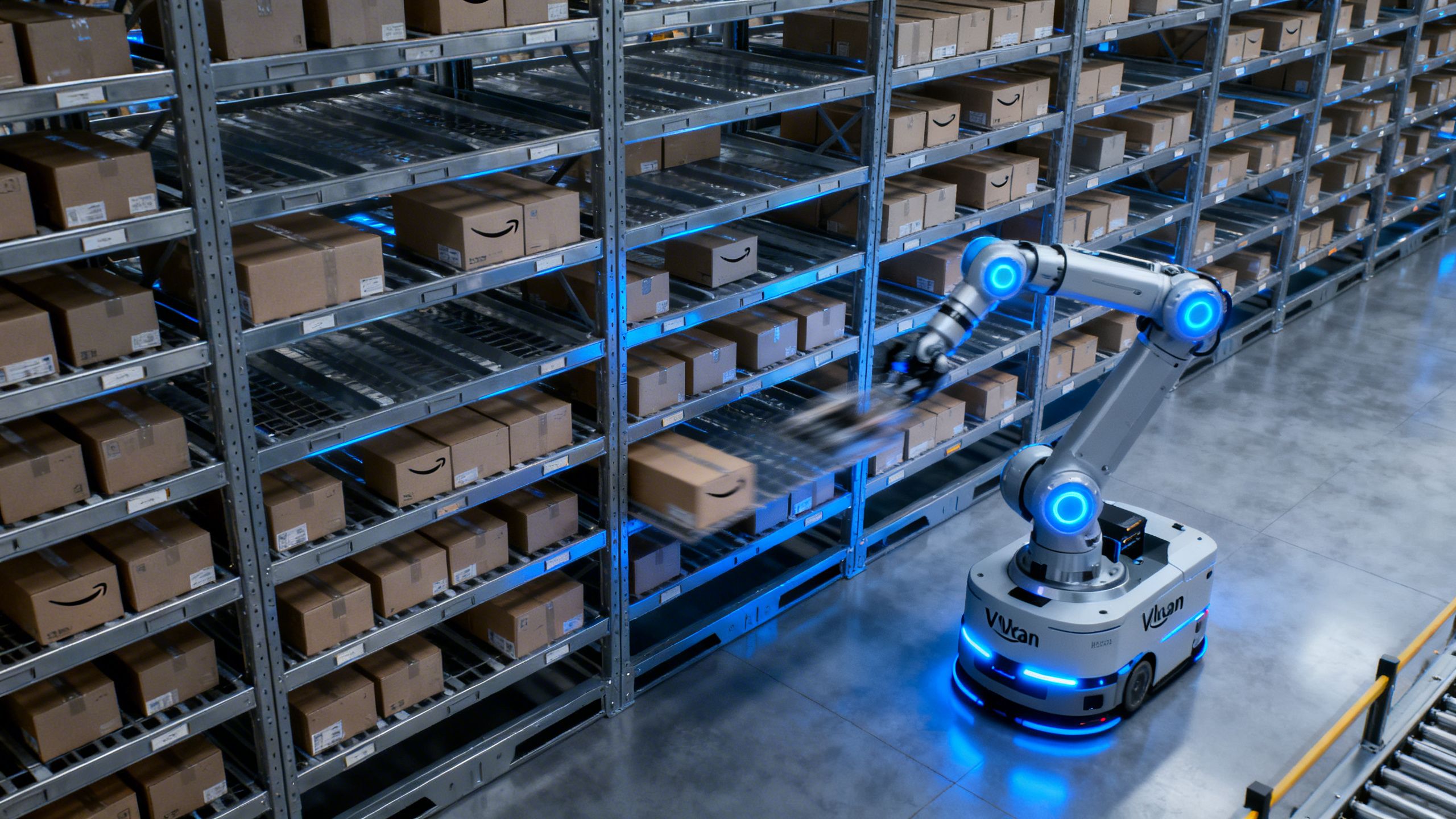
• Robots with a Sense of Touch: Amazon's new Vulcan robots use advanced AI and force sensors to physically interact with products, a massive leap in eCommerce robotic automation that goes beyond simple pick-and-place.
• Human-Robot Collaboration: Vulcan is designed to work with human employees, handling the highest and lowest shelves to improve ergonomics and efficiency, proving that the future of automation is collaborative, not just a total replacement.
• Intelligence Over Brute Force: The real magic is the AI brain—using computer vision, machine learning, and even synthetic data to handle randomly packed bins. The lesson for sellers: specialized, context-aware AI is the key to unlocking real growth.
—
Ever feel like you’re playing checkers while Amazon is playing 5D chess in another dimension? You’re not alone. Just when you think you’ve mastered the FBA game, a new update, algorithm, or, in this case, a literal robot army, comes along to change the landscape. Meet Vulcan, Amazon’s latest innovation in its fulfillment centers. These aren't your grandpa's clunky, cage-bound industrial robots. These are sophisticated machines with a sense of touch, and they offer a masterclass in the future of eCommerce robotic automation.
But this isn't just a story about cool robots. It's a look under the hood of the world's most advanced logistics machine to extract the principles that you, an ambitious eCommerce seller or agency, can apply to your own business. You don't need a multi-million dollar robotics lab to start thinking like Amazon. You just need the right framework and the right co-pilot. Let's dive in.
What is High-Contact Robotic Automation, Anyway?
For decades, the golden rule of industrial robots was simple: don't touch anything you're not supposed to. They moved through pre-defined paths in free space, and any unexpected contact was an error, a failure, a reason to sound alarms. They operated with the grace of a surgeon who’s terrified of touching the patient.
High-contact automation, the paradigm behind Vulcan, flips this script entirely. It’s built on the idea that physical interaction is not only inevitable but desirable for navigating complex, real-world environments.
As Amazon Robotics director Aaron Parness puts it, “When you as a person pick up a coin off a table, you don't command your fingers to go exactly to the specific point... You actually touch the table first, and then you slide your fingers along the table until you contact the coin... our robots are doing the same thing.”
This is the core of the revolution: using touch and force feedback, combined with advanced vision, to maneuver in cluttered, unpredictable spaces—like a fabric storage pod packed with everything from t-shirts to toasters.
Why This Robotic Revolution Matters for Your Brand
Okay, fascinating stuff. But why should you care about a robot you'll likely never own? Because the principles driving Vulcan's success are the same ones that will separate the winning brands from the rest in the coming years.
Unlocking Superhuman Efficiency (and No More Stepladders)
The most obvious benefit is a massive boost in operational efficiency. The Vulcan robots are designed to handle the highest and lowest shelves in a fulfillment center—the ones that are ergonomically challenging for human workers. This not only speeds up the process but also makes the workplace safer.
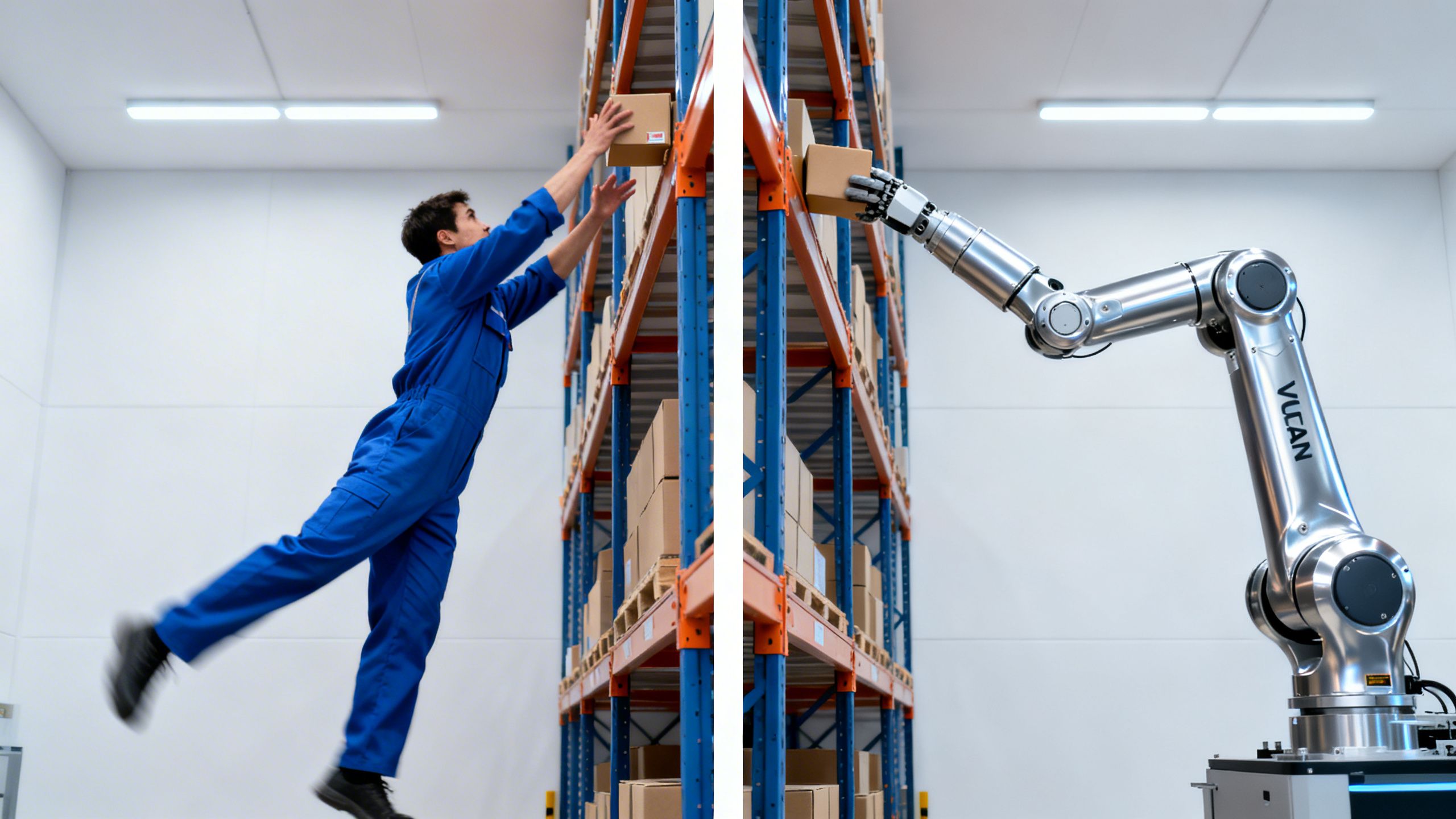
By automating these repetitive, physically demanding tasks, Amazon can:
- Maximize Storage Density: Use every cubic inch of the warehouse.
- Operate 24/7: Robots don't need breaks or sleep.
- Reduce Errors: The system's AI and imaging minimize mistakes in stowing and picking.
This relentless drive for efficiency is what allows for services like Prime shipping. For sellers, it’s a reminder that optimizing every step of your own supply chain, from inventory forecasting to ad spend, is critical.
From Brute Force to Big Brains: The AI Advantage
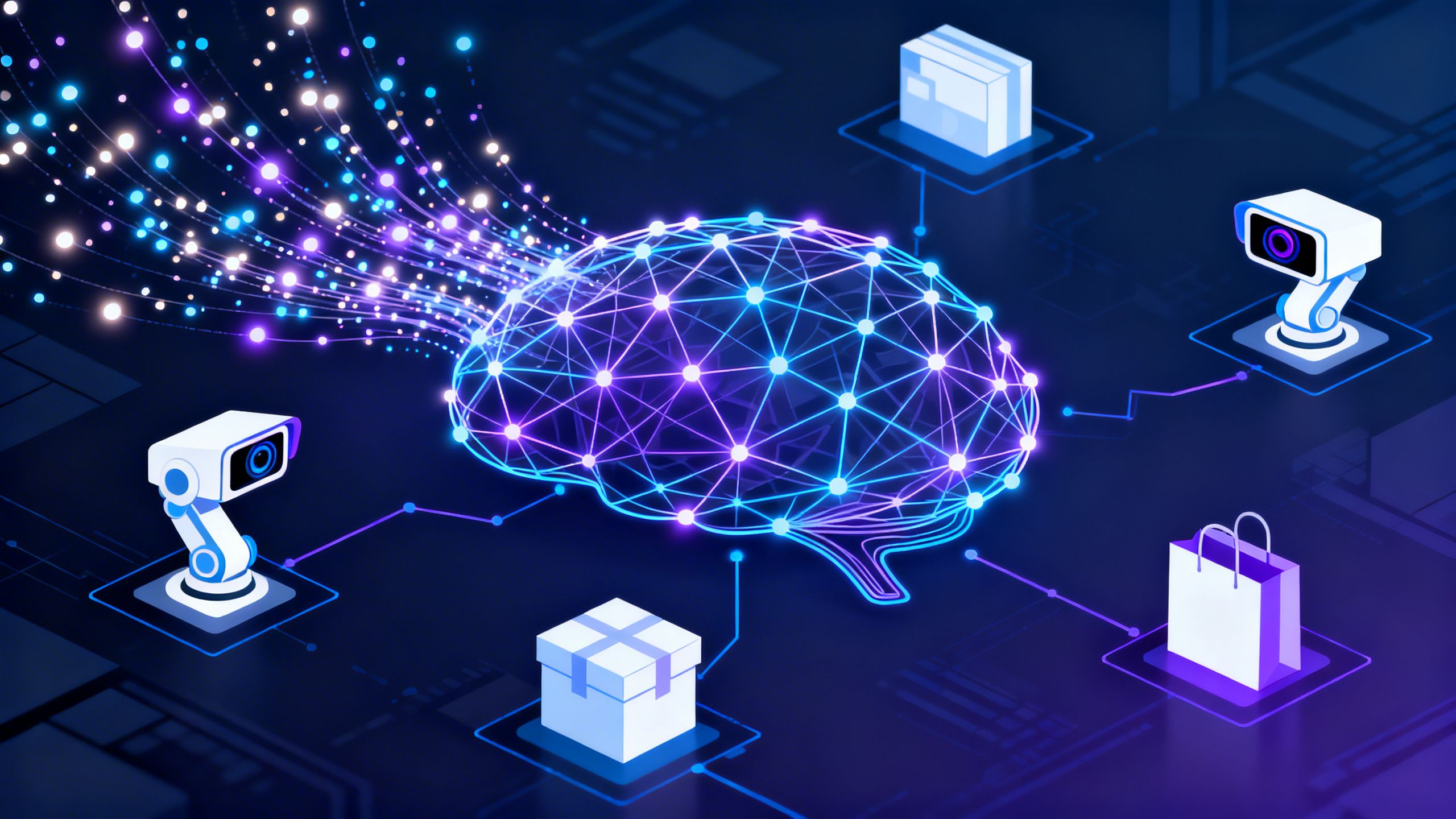
The real game-changer isn't the hardware; it's the software. Vulcan's ability to function comes from a symphony of advanced AI technologies working in concert.
- Computer Vision: Multiple stereo cameras build a precise 3D model of every bin and its contents.
- Machine Learning: Deep learning models segment the images, identifying items, elastic bands, and free space. One model was even trained on synthetic images generated by AI to better understand how to see past the pod's elastic bands.
- Predictive Physics: The AI has to reason about the physical world. It predicts how a pile of shirts will shift if pushed, or how much force is needed to move a heavy object versus a light one.
This is the essence of modern eCommerce robotic automation: it's not just about automating movement, but about automating decision-making in a complex environment.
Deconstructing the Vulcan: A Step-by-Step Guide to the Magic
So how does it actually work? The process is divided into two key functions: stowing (putting items away) and picking (retrieving items for an order). Each has its own specialized tool and algorithm.
Step 1: The Stow — Playing 3D Tetris with Your Inventory
When a new item needs to be stored, the Stow robot gets to work. Its goal is to find a bin with enough space and place the item securely.
- Receive & Scan: The robot's gripper receives an item from a conveyor belt while its cameras build a 3D model of the storage pod.
- Find Space: The AI analyzes the 3D model, calculating the free space in each bin. It's not just looking for one big empty spot; it can identify multiple small spots that can be combined.
- Make Room: If there isn't a clear opening, the robot uses an extensible aluminum attachment—basically a smart spatula—to gently push other items to the side, consolidating the free space.
- Insert: The gripper moves into position, and its built-in conveyor belts slide the item smoothly into the newly created space.
Key Tip: This “make room” step is revolutionary. It’s proactive problem-solving, not just passive execution. The best automation tools don't just follow orders; they anticipate and resolve obstacles.
Step 2: The Pick — The Art of the Gentle Snatch
When a customer order comes in, the Pick robot takes over. Its job is to retrieve a specific item from a potentially cluttered bin.
- Eligibility Check: First, an algorithm decides if the item is even eligible for a robotic pick. If it's buried under too many other things, the task is routed to a human.
- Identify & Target: The robot uses its own camera and a product-matching model to identify the correct item in the bin. This model uses contrastive learning to match products on the fly, without needing to scan a barcode.
- Find a Grip: The AI identifies flat surfaces on the target item that are good adhesion points for its suction tool, while also calculating a path that avoids collisions.
- Extract & Monitor: The suction tool attaches and begins to pull the item out. During extraction, the camera captures 10 images per second to ensure the bin's contents haven't shifted dangerously. If the grip fails, it tries another spot before passing the task to a human.
Key Tip: The system's ability to try, fail, and try again is crucial. True intelligence isn't about being perfect every time; it's about being resilient and adaptive.
Step 3: The Ghost in the Machine — How Vulcan Thinks
Underpinning both processes is the AI brain. It's not a single program but a collection of specialized models:
- Segmentation Models: Three different deep-learning models work together to segment the visual data into distinct categories: elastic bands, bins, and the objects inside.
- Affordance Models: A machine learning model generates “affordances”—essentially, a map of possible actions. It indicates where the spatula can push, where the gripper can insert, and where the suction cup can attach.
- Reasoning Layer: This is what Parness calls the “unique” part. It’s the AI’s ability to reason about physics and predict the outcome of its actions.
This multi-layered AI approach is a powerful lesson in building robust automation.
eCommerce Robotic Automation: Lessons from the Vulcan Project
You don't need to build a robot to apply these lessons. The strategic thinking behind Vulcan can be directly translated to how you manage your brand on Amazon.
Specialized Practice: Embrace Context-Aware AI
Vulcan isn't a general-purpose robot asked to learn fulfillment; it's a highly specialized machine built for one context. Its AI was trained on images of Amazon's specific storage pods, its gripper was designed for the items Amazon sells, and its algorithms are tuned for the physics of a warehouse.
Generic tools provide generic insights. To win, you need specialized AI that understands the unique context of your business. This is true for everything from inventory management to advertising. A generic analytics tool can show you sales data; a specialized tool can tell you why your sales dipped last Tuesday and what to do about it.
Specialized Practice: Prioritize Data and Continuous Learning
Vulcan's AI is constantly learning. It learns from every pick and stow, and its models were even trained on synthetic data to get ahead of real-world challenges. The product-matching model is a “general-purpose product matcher” because it learned the concept of similarity through contrastive learning, not by memorizing a catalog.
Your business generates a goldmine of data every day. Are you using it to learn and adapt? Or is it sitting in a spreadsheet, ignored? The most successful brands build systems—or use tools—that create a feedback loop, turning today's performance into tomorrow's strategy.
From the Warehouse to Your Dashboard: Applying These Principles
Let's bring this down from the clouds. How can you, a seller or agency owner, use these high-minded principles to make more money next month?
Specific Scenario: Automating Your Inventory 'Sixth Sense'
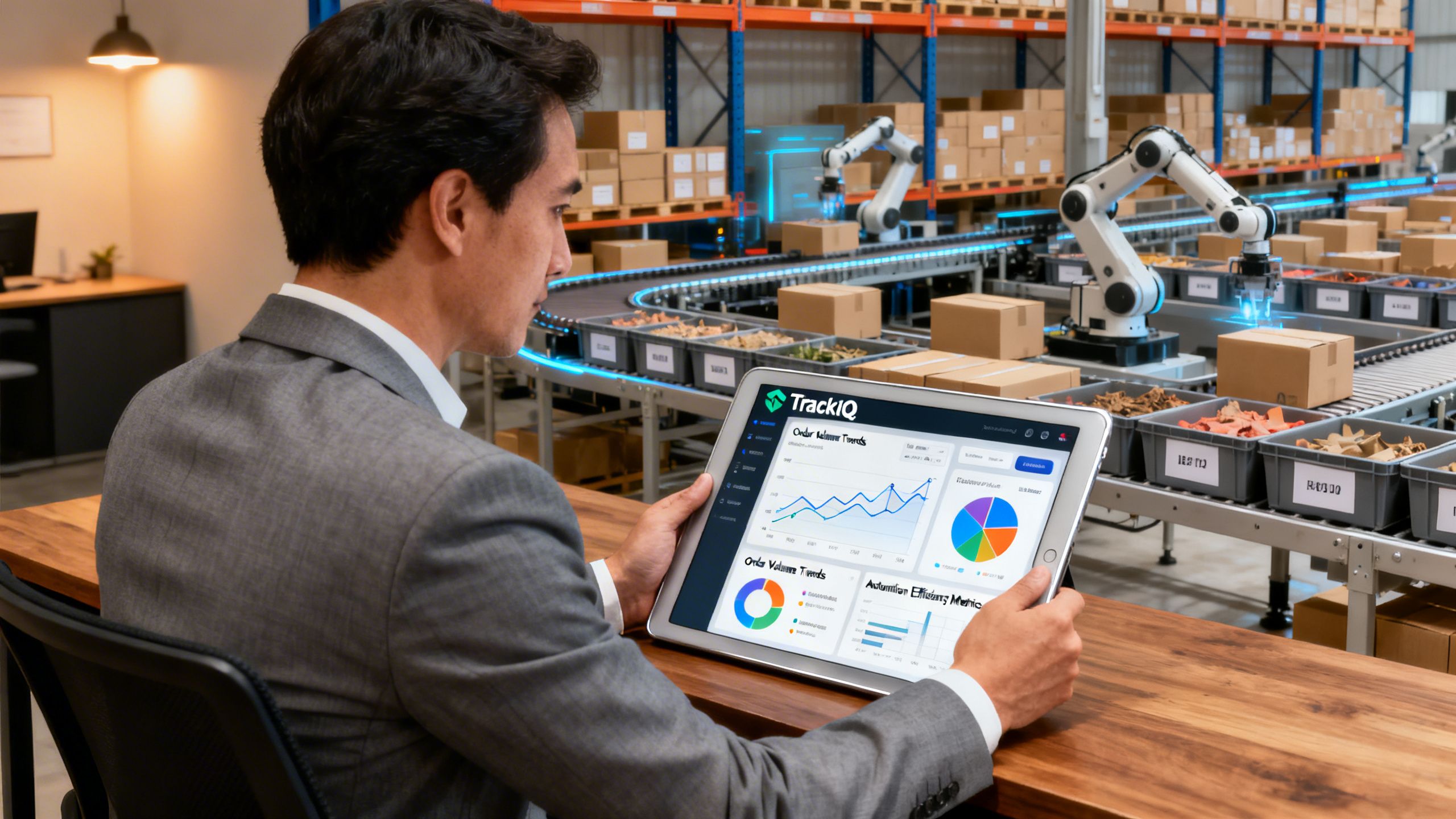
Vulcan has a real-time, 3D understanding of its inventory. You need the same for your business. Relying on Amazon's basic reports is like trying to navigate a maze with a blurry, week-old map. You need a system that gives you a clear, real-time picture.
- Challenge: You're constantly at risk of stocking out of your bestseller or being overstocked on a slow-mover, tying up cash.
- Solution: Instead of manual spreadsheet analysis, you use an intelligent platform that analyzes your sales velocity, seasonality, and inventory levels 24/7. It doesn't just report the numbers; it alerts you to anomalies and provides actionable forecasts.
- Result: You avoid costly stockouts, reduce storage fees, and free up capital to invest in growth.
Specific Scenario: Deploying an 'Agentic AI' for Growth
Vulcan is a prime example of an “agentic AI”—an AI that can understand a goal, break it down into steps, and execute a complex task. This is the future of AI, moving beyond simple calculators to become proactive partners. You can apply this same concept to your growth strategy.
- Challenge: Managing Amazon PPC is a complex, time-consuming nightmare of keyword research, bid adjustments, and report analysis.
- Solution: You deploy an AI co-pilot that acts as an agent. You give it a goal (e.g., “launch a new campaign for Product X with a target ACoS of 25%”), and it handles the multi-step execution: researching keywords, structuring the campaign, setting initial bids, and monitoring performance.
- Result: You save hours of manual work every week and get better results because the AI can analyze thousands of data points in real-time to make smarter decisions.
Common Pitfalls in Adopting eCommerce Automation
As with any powerful technology, there are traps for the unwary. Here are two major pitfalls to avoid when thinking about automation for your brand.

The 'Set It and Forget It' Fantasy
One of the biggest mistakes is thinking automation is a magic button you press once. Even Amazon's hyper-sophisticated Vulcan robots have checks, balances, and human oversight. The system is designed to pass difficult tasks to humans.
Don't fall for the promise of fully autonomous, set-and-forget solutions. The best automation enhances human intelligence, it doesn't replace it. You need a system that works with you, surfacing insights and asking for your strategic input on the most important decisions.
Ignoring the Human-Robot Partnership
Amazon's strategy is telling: Vulcan robots are augmenting human workers, not replacing them entirely. They're taking over the most strenuous tasks, freeing up people to handle more complex problems that still require human dexterity and judgment (like handling fragile items).
This collaborative model is the key. Your goal shouldn't be to automate yourself out of a job. It should be to automate the tedious, repetitive, and data-intensive tasks so you can focus your time on strategy, creative, and building your brand.
Why TrackIQ Matters: Your Co-Pilot for Intelligent Automation
This brings us to the core idea. You don't need to be a robotics expert to benefit from the principles of eCommerce robotic automation. You just need a co-pilot that brings this level of intelligence to your business operations.
Just as Vulcan acts as a physical co-pilot for warehouse workers, TrackIQ is designed to be your digital co-pilot for Amazon growth. It’s not another dumb dashboard. It’s an intelligent system built on the same principles we see in Vulcan:
- Specialized, Context-Aware AI: TrackIQ is built exclusively for Amazon. It understands the unique physics of the Amazon flywheel—how advertising, inventory, pricing, and operations all interact. It speaks the language of ACoS, TACOS, IPI scores, and sales velocity.
- From Data to Decision: It doesn't just show you charts. It uses its AI to surface insights, identify anomalies, and answer plain-English questions about your business. It connects the dots between your ad spend and your total profit, something notoriously difficult to do.
- A Trusted, Safe Partner: In a world of black-box AI, trust is everything. You need to know that the recommendations you're getting are sound. TrackIQ is built with a focus on AI safety and reliability, ensuring it's a co-pilot you can count on to have your back.
Conclusion
The rise of robots like Vulcan isn't a sci-fi movie plot; it's a practical demonstration of where the world of commerce is heading. The future belongs to those who can effectively partner with intelligent systems to work smarter, faster, and more efficiently.
Here are the key takeaways for your brand:
- The future of automation is collaborative and intelligent, not just repetitive. It’s about augmenting human skill, not replacing it.
- The principles behind advanced robotics—specialized AI, real-time data feedback loops, and continuous learning—are directly applicable to managing a modern eCommerce business.
- You don't need a multi-million dollar robot; you need an intelligent digital co-pilot to help you navigate the ever-increasing complexity of the Amazon marketplace.
Stop trying to manually pilot a rocket ship with a bicycle helmet. The tools are now available to give your brand the intelligent automation it needs to compete and win. It's time to embrace your new AI co-pilot.
—