Agentic AI: Your eCommerce Business's New Superpowered Intern Who Never Sleeps

Quick Summary (TL;DR)
• AI as a Colleague, Not a Calculator: Agentic AI isn't just another automation tool; it's a proactive partner that can execute multi-step tasks, from market research to inventory management, freeing you up for strategic work.
• It Learns Your Business's Quirks: Unlike rigid scripts, Agentic AI learns to navigate the messy, real-world systems you use every day—like clunky supplier portals or complex ERPs—by understanding their flaws and workarounds.
• The 24/7 Growth Engine: For Amazon sellers, this means having a co-pilot that constantly monitors competitors, optimizes pricing, manages inventory, and surfaces insights you didn't even know to look for, giving you a massive competitive edge.
—
It’s 11 PM on a Tuesday. You’re staring at a spreadsheet so vast it seems to have its own gravitational pull. You have ten browser tabs open: Seller Central, your supplier’s 1990s-era ordering portal, three different competitor listings, your 3PL dashboard, Google Analytics, and a few others you’ve forgotten about. You're manually cross-referencing sales velocity against inventory levels to decide if you need to place a purchase order. This is the glamorous life of an eCommerce entrepreneur, right?
What if you had a brilliant intern? One who never sleeps, never complains, and can perform that entire workflow in seconds. What if this intern could also spot that your main competitor just went out of stock, suggest a 5% price increase to capitalize on it, and then draft the PO for you? That’s not an intern; that's Agentic AI, and it’s about to fundamentally change how you run your business. This isn't just another piece of software; it's a new member of your team.

So, What Exactly is Agentic AI? (And Why Isn't It Just Another Chatbot?)
Let's get one thing straight: Agentic AI is not the same as the chatbot that pops up asking, “Can I help you?” while you’re trying to buy socks. A simple AI tool follows a script. You give it command A, it performs action B. It's a calculator.
Agentic AI, on the other hand, is a doer. It’s an autonomous system that can perceive its environment, make decisions, and take actions to achieve a specific goal. Think of it less like a calculator and more like a mission-driven project manager. You don't give it a single command; you give it a mission: “Maximize my profit on ASIN X without letting my IPI score drop.”
The agent then breaks that down into a series of actions: monitor competitor prices, analyze ad spend, check inventory levels, forecast demand, and adjust variables accordingly. It operates across multiple steps and even multiple platforms, learning and adapting as it goes.
Why Agentic AI is a Game-Changer for Amazon Sellers
For anyone selling on Amazon or managing brands, the environment is a chaotic mix of high-stakes decisions and mind-numbing manual tasks. Agentic AI thrives in this chaos.
Taming the Beast: Navigating Complex Systems
Your business doesn't run on one perfect, clean system. It runs on a messy web of platforms: Amazon's ever-changing Seller Central, a clunky ERP, a supplier portal that looks like it was built during the dial-up era, and a dozen other SaaS tools. Traditional automation breaks when one of these systems has a hiccup.
As researchers at Amazon's AGI Labs found, the key is “learning the bad to heal the bad.” An Agentic AI learns the system's real behavior—the quirks, the delays, the button you have to click twice. It learns the institutional knowledge that’s currently stuck in your head.
This means your AI co-pilot won't crash because your supplier's website took too long to load. It will wait, retry, and complete the mission, just like a person would.

Beyond Automation: Proactive Strategy and Execution
Standard automation is reactive. Agentic AI is proactive. It doesn't just pull a report you asked for; it analyzes the data and suggests what to do next. It connects dots you don't have time to see.
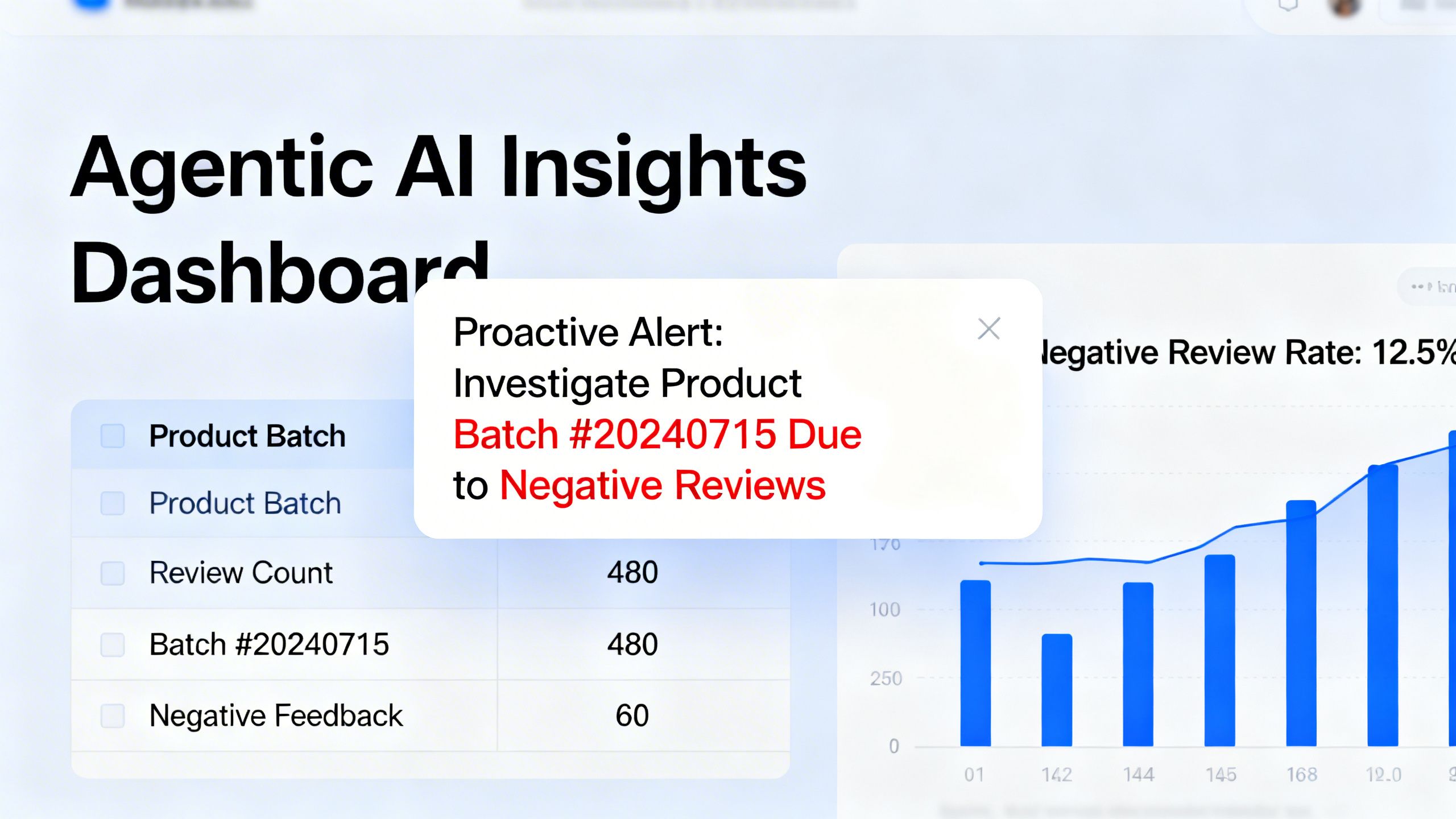
- Scenario: An agent notices a sudden spike in negative reviews mentioning “broken seal.”
- Standard Automation: Maybe it sends you an alert.
- Agentic AI: It alerts you, flags the specific FBA batch associated with the complaints, pulls up recent changes in packaging from your supplier, and suggests pausing ads on that ASIN until you can investigate the inventory at the fulfillment center. It turns a potential disaster into a manageable problem.
This is the difference between having a tool and having a teammate.
Putting Your AI Agent to Work: A 3-Step Guide
This all sounds great, but how do you actually implement it? It’s about shifting your mindset from giving commands to defining missions.
Step 1: Define the Mission (Not Just the Task)
Stop thinking in single steps. Instead of “Export sales data from Seller Central every day at 9 AM,” think about the ultimate goal.
A better mission for an Agentic AI would be: “Monitor my top 5 ASINs. Alert me to any significant changes in sales rank, competitor pricing, or inventory levels, and then suggest an action plan to either defend my rank or capitalize on an opportunity.” The AI handles the how; you just define the what and why.
Key Tip: Start with a high-value, repetitive, multi-system task that eats up your team's time. Inventory forecasting and competitor monitoring are perfect candidates.
Step 2: Granting Access (The Right Way)
For an agent to work, it needs to “see” and “interact with” the same interfaces your team uses. This means granting it secure access to platforms like Seller Central, your ad console, and other tools. This can feel daunting, but platforms designed for this build security in from the ground up.
Key Tip: Think of it like onboarding a new employee. You give them the logins they need, but nothing more. Use a trusted platform like TrackIQ that uses secure, API-based connections and has robust security protocols designed for the Amazon ecosystem.
Step 3: The Feedback Loop: Train, Test, and Trust
Your AI agent won't be perfect on day one. It learns from doing, and more importantly, from its mistakes. The process is a feedback loop:
- Assign a Mission: Give it a clear, measurable goal.
- Supervise: Watch how it performs the task. Does it get stuck? Does it make a weird choice?
- Correct: Provide feedback. This correction teaches the agent the “folklore” of your business—the unwritten rules and nuances. This is the core of AI alignment, ensuring your AI is working towards your actual goals. Is your AI learning the right lessons? It's a critical question to ask as you build this trust.
This collaborative training is what turns a generic tool into your personalized co-pilot. It's about treating the AI like a brilliant colleague, not just a calculator.
Agentic AI in Action: Real-World eCommerce Scenarios
Let's move from theory to practice. Here’s what this looks like on a Tuesday morning.
The Autonomous Inventory Manager
An Agentic AI can be tasked with preventing stockouts. It continuously:
- Monitors sales velocity and trends on Amazon for your top products.
- Checks real-time inventory levels in your 3PL or warehouse system.
- Accesses your supplier's portal to confirm current lead times.
- Calculates the optimal reorder point based on all this data.
- When the threshold is hit, it drafts a purchase order, calculates the ideal quantity, and sends it to you for one-click approval.
This single workflow saves hours of manual work and prevents costly stockouts.
The 24/7 Competitor Watchdog
Imagine an agent dedicated to competitive intelligence. It constantly scrapes the top 10 competitor listings for your main keyword, tracking:
- Price changes
- New reviews (and their sentiment)
- Changes to listing copy or images
- Stock status and seller count
If a key competitor runs out of stock, the agent can instantly alert you and suggest a temporary 5% price increase to maximize margin while demand is high. When the competitor is back in stock, it suggests returning the price to normal. That’s proactive profit generation while you sleep.
Why TrackIQ Matters: From Agentic Theory to eCommerce Reality
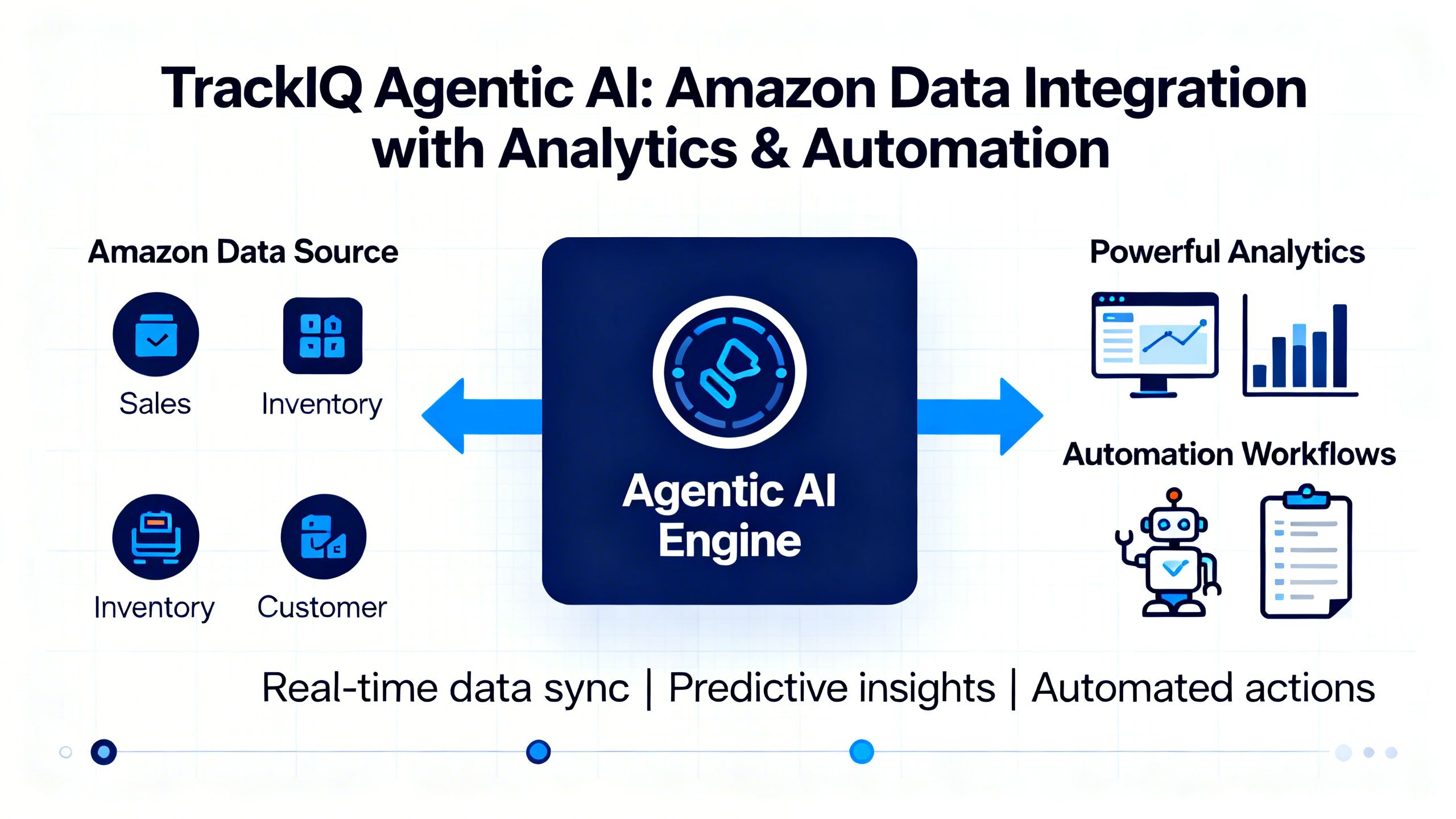
Building, training, and safely deploying a private Agentic AI is a massive undertaking requiring a team of specialized engineers. The good news? You don't have to.
This is where TrackIQ comes in. We've built the Agentic AI platform specifically for the Amazon ecosystem. We’ve already done the hard work of teaching our agents the quirks of Seller Central, the nuances of Amazon advertising, and the complexities of inventory management.
Instead of you having to build an agent from scratch, TrackIQ provides a ready-to-deploy co-pilot that understands your world. The scenarios described above—like the Autonomous Inventory Manager and the Competitor Watchdog—aren't theoretical futures; they are capabilities you can leverage today. TrackIQ isn't just another analytics dashboard; it's an action-oriented partner designed to execute on the insights it finds, turning hours of manual work into a simple conversation.
Common Pitfalls When Adopting AI Agents (And How to Dodge Them)
Jumping into Agentic AI without a plan can lead to frustration. Here are two common traps to avoid.
The 'Garbage In, Garbage Out' Problem
An AI agent is only as good as the data it can access and the goals you give it. If your inventory data is a mess or your objectives are vague (“make more money”), the agent will struggle. Before you deploy an agent, ensure you have a clean source of truth for your most critical data (sales, inventory, costs).
Expecting Perfection on Day One
Remember the intern analogy? You wouldn't expect a new hire to run the company on their first day. The same goes for your AI agent. It needs time to learn the specifics of your business. Start with supervised tasks, provide feedback, and gradually grant more autonomy as it proves its reliability. This is a partnership that builds over time. For a deeper dive on this, understanding AI alignment is crucial to ensure your AI's actions match your intentions.
Level Up: Advanced Agentic AI Strategies
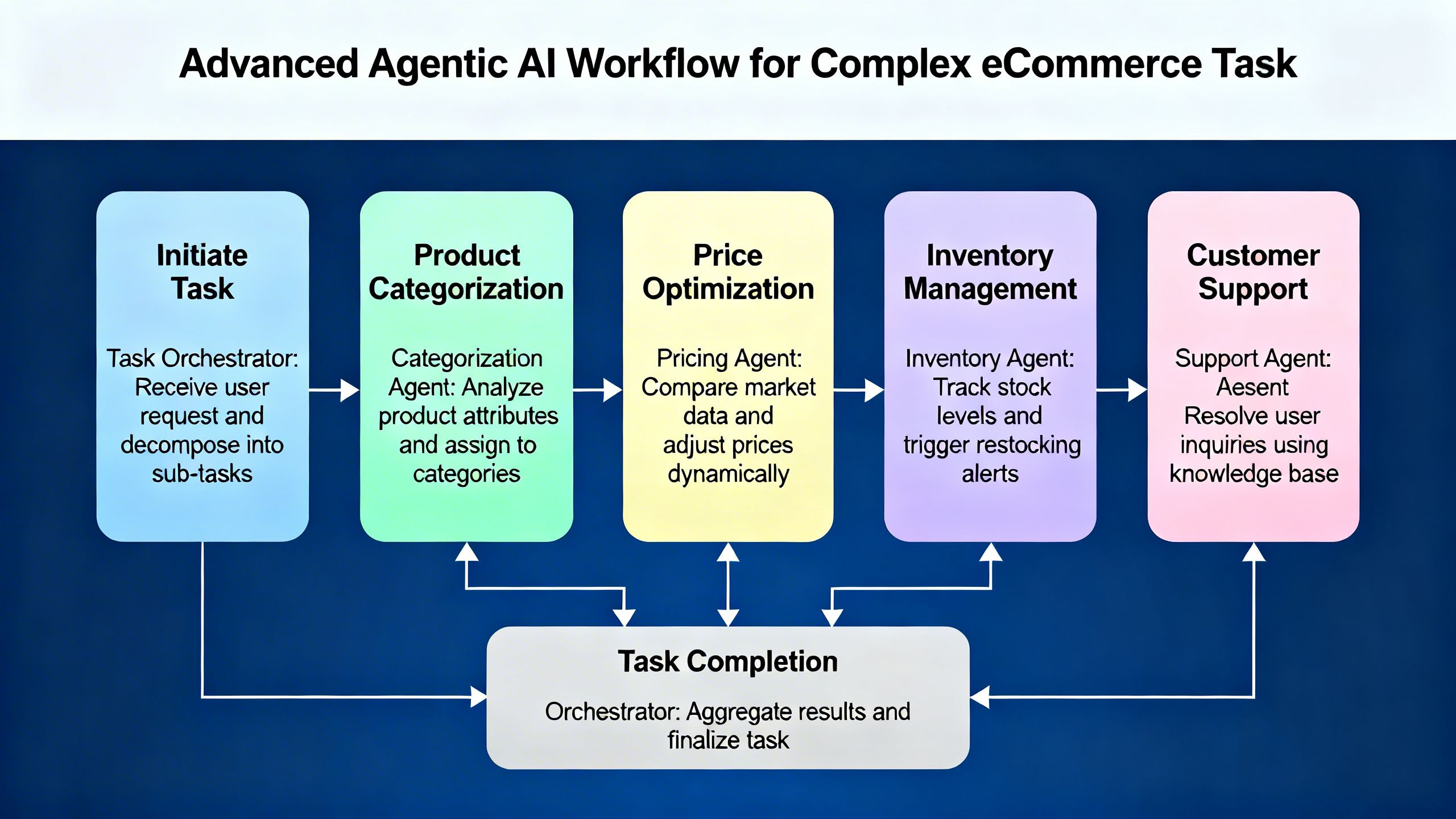
Once you've mastered the basics, you can start orchestrating multiple agents to perform incredibly complex workflows. For example:
- Agent 1 (The Researcher): Monitors social media and competitor reviews for emerging product trends or feature requests.
- Agent 2 (The Creative): Takes the researcher's findings to generate new product ideas or A+ Content concepts.
- Agent 3 (The Analyst): Once a new product is launched, this agent monitors its performance, compares it to the initial research, and provides feedback to the other agents, creating a self-improving R&D loop.
This is the future of eCommerce operations: a team of specialized AI agents working in concert, managed by human strategists who are free to focus on the big picture.
Your Takeaways: The Future is Agentic
If you're still spending your nights in spreadsheet hell, it's time for a new approach. The era of passive tools is ending, and the era of the active, agentic partner is beginning.
Think Co-Pilot, Not Calculator: Start viewing AI as a strategic partner that can handle complex workflows, not just a simple automation tool.
Embrace the Quirks: The real power of Agentic AI is its ability to learn and navigate the imperfect, real-world systems your business relies on every day.
Start Small, Scale Smart: Identify one high-impact, repetitive task and explore how an agentic platform could solve it. Don't try to boil the ocean.
Conclusion
The shift to Agentic AI is not about replacing people. It's about augmenting them. It’s about freeing up your time, energy, and brainpower from the monotonous, repetitive tasks that bog you down, allowing you to focus on what humans do best: strategy, creativity, and building relationships. It’s about finally getting out of the weeds and back to building your vision.
Ready to stop clicking buttons and start making decisions? See how TrackIQ's Agentic AI can become your 24/7 co-pilot and give you back your time.
—